What Death Teaches Us About Life

death1

Death…it is a topic most of us do not like to talk about much less think about.

Unless we are quite old or in very bad health, death is something that is probably NOT on the forefront of our mind.

In fact, if anything we may feel that we still have PLENTY of time ahead of us.

Plenty of time to….travel

Plenty of time to….get serious about our health

Plenty of time to….fall in love

Plenty of time to…..have children

Plenty of time to…..pursue our dreams

Plenty of time to….mend fences

Plenty of time to…get our finances in order

Plenty of time to…..change careers

Plenty of time to…..????

Fill in the blank. What is it that YOU feel you still have plenty of time to do?
death6

Maybe you are reading this and you do not know what to fill in your blank with. Many of us never pay mind to the fact that every day that passes, we are all one day closer to death.

It is a morbid truth. A morbid truth many of us avoid thinking about.

In my life death is a topic that is ever-present as my husband is a funeral director. Death is a part of his daily life.

As a therapist, I have also worked with clients through the stages of grief that the death of a loved one brings about.

For these somewhat unique reasons I have very much been influenced by truths about life and death.

Death is something that can shake us to our core.

It can cause an existential crisis–leading us to question EVERYTHING about our life.

Death is something many of us struggle with facing–whether it is our own eventual passing or the passing of a love one.

However, life and death are a package deal. Once we are born, we ALL will inevitably meet the same ending. Everyone we love and care for will eventual pass away.

We too shall pass.

Throughout our lives, there are lessons to be learned from ALL our life experiences. Death of my loved ones has taught me much. It made me realize I do not have all the time in the world.  Some days I wake up and I cannot believe how quickly life is flying by. Some days I can’t believe how many years I have already lived.

death8.jpg

Knowing we all will eventually die should be a gentle reminder that while there is plenty of time, there is not unlimited time.

death2

Death is the reminder that our time here on Earth is so brief in the grand scheme of things. If Earth is billions of years old and we all get on average about 80 years on the planet, we are all here oh so briefly…

Death is so final. So permanent. So life changing.

Facing it sounds terrifying. Watching someone you love face it is heart breaking.

The reality is my experiences with death and the dying have shaped my life. My priorities have shifted. My idea of what makes a meaningful life has evolved.

Death has a way of recalibrating our values, goals, and views on relationships.

My relationships have changed. I know who my tribe is and I let them know as often as I can how much I appreciate them. I aim to say I love you as often I can to all of my loved ones. I offer encouragement. I provide a shoulder to lean on to those I care about. I try to be generous and thoughtful. Often the time I take off from work is to visit those I love who are scattered across the country.

The realization of how short life is has made me stop spending time with people who don’t value me. No longer do I give my time to just anyone. I don’t feel the need to engage in petty arguments with petty people. I avoid people whose favorite pastime is gossiping. People who are self-centered are no longer part of my inner circle. I will exit stage left from people who show they don’t care. No fuss, no drama, just a quiet retreat.

Of course, I am human and do from time to time waste my time on the trivial. I get sucked into the petty. I sweat the small stuff. I get caught up in nonsense. It is usually shortly after the fact that I realize my time could have been better spent.

Death makes us realize how much of our time is spent on things that don’t even matter.

Death changes people. I believe in the power of people to evolve and grow. Death can be the catalyst for growth.

Death has taught me about the importance of forgiveness. If someone hurts me, comes back into my life with remorse, my heart would welcome almost anyone back.

Compassion is one of the things death has taught me about life.

death9

The fact that life is short has contributed to me choosing a career that is about more than just earning a paycheck. Over our lifetime, we spend many of our days at work and I want my career to be about more than just making the most amount of money possible. My time is limited and I want to try to derive meaning from how I earn a living.

I do not want the thousands of hours a year spent at work just to be about dollars and figures.

Death and the realization of how limited our time is has shaped my perspective.
death4

What can death teach us all?

  1. It has this way of showing us the meaning of life and how foolish it is to spend our time sweating the small stuff. Ask yourself, Does this REALLY matter in the grand scheme of things? If it doesn’t let it go.
  2. Life is uncertain. We never know what tomorrow will bring. Enjoy each day. Don’t let a bad day feel like a bad life.
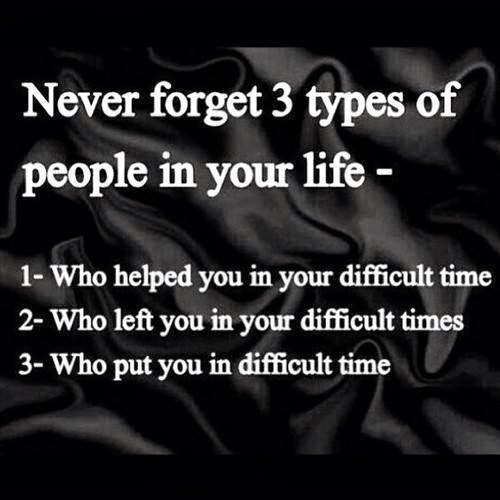
  3. Give second chances. To people who deserve it. Don’t give second chances to people who do not. Your time is precious and it is the one things NONE of us can get back.death 5
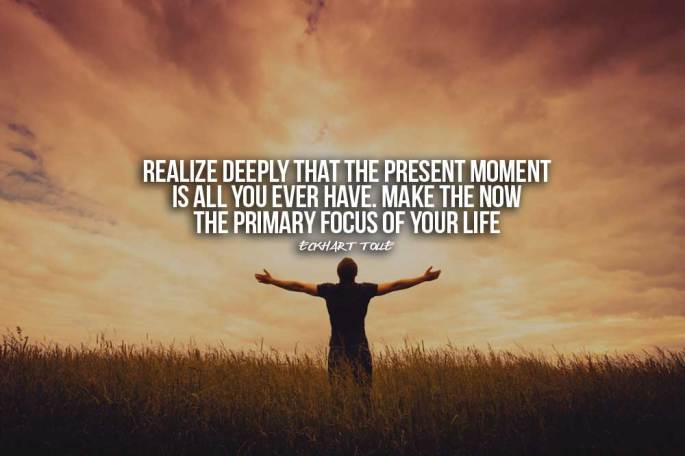
  4. The present moment. Cherish it. It is all we have.death3
  5. Life is precious and short. Don’t wait.
  6. Death reminds us of our own humanity and can teach humility. Stay humble.
  7. Death is a game changer. I often ask clients who are struggling the following types of questions:  What would you do if you only had weeks to live? Who would you want to spend your time with? Where would you like to go? What would you spend your last weeks doing? What would your IDEAL life look like?

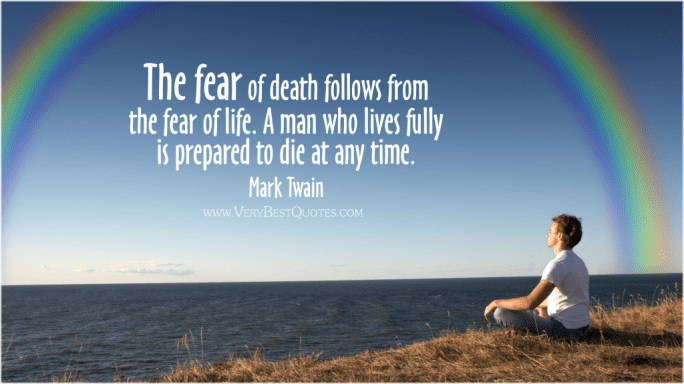
WHAT DO YOU WANT TO DO WITH THE TIME YOU HAVE LEFT?
death 10.png

To schedule a counseling session with me (AND if you are a reader in New Jersey):

https://anewcounselingservices.com/erin-theodorou%2Cm-ed-%2C-lpc


Why We Overeat~The Psychology of Binge Eating

a1

Ever ask yourself why you overeat? Despite repeated attempts to live a healthy lifestyle and treat your body well–do you find eating a moderate, balanced diet continues to be an ongoing struggle?

Can you remember the last time you ate to the point you were stuffed?

How did you feel afterwards? Ashamed? Guilty?

If this sounds familiar–don’t worry, you are in good company.

It is no secret that many Americans are overweight and obesity is an ongoing epidemic.

Even for people who are not overweight or obese, they may still struggle with binge eating.

If you are someone who overindulges occasionally–that is completely normal.

Who among us has not pigged-out from time to time? We all pile of the stuffing on Thanksgiving or eat that extra piece of cake on our birthday.

The problem is when overeating because our norm and not the anomaly.

a2

Clients often tell me, “I eat when I am hungry, I eat when I am sad, I love to eat.”

What that is telling me is more is going on here than just a person who eats to satisfy hunger and be healthy.

With chronic binge eaters there are three characteristics usually shared:

1)A hard time resisting favorite foods (a lost of control)

2)A hard time stopping once eating begins (issue with satiation)

3)A preoccupation with food (often an obsession)

For some people reading this, you can’t even begin to relate to what I am saying at all. People who do not struggle with binge eating would not relate to these three characteristics. But for the many of us who struggle with overeating–this probably hits close to home. We yo-yo diet and struggle with keeping the pounds off. And it feels like it is beyond our control.

a3

Where does this power that food has over us come from? 

1)Taste (the memory of your favorite food)

2)Anticipation of the taste

3)Our brains get cued by external stimuli (example you always go on a yearly  vacation to the beach and eat salt water taffy–the smell of the ocean alone triggers the craving)

4)Our brain’s amygdala is activated and wants us to get whatever it is we are craving (the brain stays active until we are stuffed).

A lot of this process is unconscious.

Part of the epidemic of obesity is arising from the growing addiction to food. 

We overeat fatty, sugary, salty foods because it changes how we feel.

As humans we respond to salient stimuli (which can be alcohol, tobacco, sex).

Food is most socially acceptable as an addiction (to be addicted to fat, sugar, salt).

For example, the norm for you may be to go out on a Friday night with your family to Applebees. You are used to ordering buffalo wings as one of the half-priced appetizers (a fatty food, that is fried in more fat, with red sauce, to be dipped in a white creamy sauce ie fat on fat on fat on sugar and salt with a LITTLE protein).

This type of food triggers the reward center in our brain.

A large part of the binge eating epidemic in our country is arising from our culture–portions have gotten out of control, the additives put in our food cause us to grow addicted, and there is a neurobiology to food addiction. Then factor in the cheapest food tends to be the unhealthiest and it is easy to understand this growing health crisis our nation is facing.

Even salads have become vehicles for delivering fat—we load them with bacon, cheese, croutons, dressing, and it is easily over 1,500 calories!

I know I love my salad covered in dressing with little mozzarella balls!

The reality is as a society we eat too much. We don’t know how to stop. Often how we socialize is centered around food.

Food is entertainment and it in our culture it has become socially acceptable to eat at any time.

Our psychology is a driving force behind our growing waistlines. Many of us deal with negative emotions by turning to food for comfort. We trade in our health for the momentary bliss that comes from indulging in sugar, fat, and salt. We get a spike of dopamine and feel a sense of euphoria. The worst part is every time we indulge we strengthen our neurocircuits to DO IT AGAIN.

On the day-to-day, we get cued, our brain is aroused by the salient stimuli, we get a reward by eating whatever IT is we are craving, and we release all the feel good chemicals in our brain that cause us to overeat again— more and more frequently!

If you are lucky, you are less receptive to dopamine-in a word dopamine makes us want (and crave). It is possible, you don’t get the dopamine surge that reinforces many people’s drive to overeat. Some people with the luck of genetics are less impulsive to this urge in general (not me, but that is what I researched. Lucky ducks).

This is a habit that often starts in childhood. Our parents use food to comfort us, reward us, and bribe us.

Clean your room and we can go get ice cream.

If you win this game, let’s go get pizza!

Even at an early age, we can see food is used as the carrot and stick to motivate us. A lot of our adult struggles with overeating stem from childhood experience and pass memories.

When we are craving something–the memory of the last time we had it and ENJOYED it floods our mind. These memories fuel our desire to eat the food and anticipate the reward we will experience from indulging in it.

Our psychological state impacts our relationship with food.

We overeat because we are often emotionally hungry.

Lonely, depressed, bored, overwhelmed, sad, angry, stressed, the list goes on and on.

Many brain neurotransmitters affect our mood and appetite. The more we indulge in overeating the worst the cycle gets.

We overeat because of external cues–watching tv, socializing, someone’s birthday at work, the vending machine at the office–whatever triggers the urge.

As a society, we are also mindless eaters. How often in life is our attention drawn somewhere else? Many of us eat in front of the tv or with our cell phone in hand or in our car as we speed to our next appointment.

In our culture, many of us are constantly going on and off diets. Dieting isn’t the solution. A change in lifestyle is the solution.

We need to shift seeing food as a reward.

Learning new ways to relieve stress is key-cortisol, the stress hormone that floods most of us on the daily, triggers an increase in appetite. Mitigating our stress is pivotal to changing our relationship with food. Modern day society with its fast paced lifestyle has resulted in elevated levels of cortisol among us all.  Being chronically stressed leaves us craving carbs and fats–particularly in the late day and evenings.

I know evening eating is a weakness of mine. Many of us eat from evening to bedtime–after all the stress from the day, the kids are in bed, food will be a nice, little reward–making us feel great for a few minutes (indulging in fatty, sugary foods activate the opioid circuitry). You feel great for a couple of minutes but then feel horrible after for breaking your healthy diet.

To overcome our struggles with overeating we need to identify our stressors. We need to replace bad habits with realistic alternatives–instead of downing a pint of Ben and Jerry’s find a pragmatic solution for how to deal with stress.

If you hate to exercise, replacing food with a walk will not work. Because you won’t want to do it. It will not be a viable replacement to binge eating. What you need to figure out are non-food ways to cope with stress.

It will be different things for all of us.

You need to new neurocircuitry to successfully stop overeating.

What circuits are we dealing with here? The learning, motivation, memory,and habit circuits.

When you are emotionally connected to yourself, you find you are less likely to feel the urge to escape through food.

How do you change your food addiction?
1)Having structure helps. Create a routine around eating. Plan out what you will eat during the day. Leaving it up to endless options=recipe for disaster.

2)We, as a society, need to change the social perception of overeating. Look at smoking–it use to be considered cool until we had what psychologists call a “critical perspective shift” where we as a society started to see tobacco as deadly and disgusting.
This perspective shift towards food has already started–at least as far as it relates to process foods and GMOs. Yet we can live without nicotine, but we cannot live without food.  Therefore it is a different type of shift we need here.

You need to change how you look and respond to food.

a4

3)We need to work on balance. Look at 2-year-old. If they eat more at lunch, they eat less at dinner. They balance it out. Adults tend NOT to balance their meals (or days or lives for that matter).

Until we change how we look at food and figure out a balance in our lives, we will continue to struggle.


To schedule a counseling session with me (AND if you are a reader in New Jersey):

https://anewcounselingservices.com/erin-theodorou%2Cm-ed-%2C-lpc
 

The Psychology of Money

a2

When you think of your personal finances, how often do you factor in your psychology?

For many of us, we view our psychology and finances as two totally separate entities with pretty much nothing in common.

Money is a social construct after all. Yet what we do with our money says a lot about how we feel and think.

Personal finance is just that-personal.

Adam Smith, the father of classic economics, loved to use the rational self-interest model. But what I am talking about is the irrational model of human behavior.

The reality is people off act irrationally, selfishly, and not in their best interest–this holds true for how they manage their finances as well at their life in general.

Have you ever wondered why you feel the way you do about money?

Maybe you are someone whose number 1 goal in life is to obtain as much money as possible.

Maybe you are someone who sees money as a necessary evil–you need it to pay bills but may hold the belief that money is the root of all evil.

Or maybe you fall somewhere in between on the spectrum.

Money is not about finances, it is about emotions.

The inner game of money is about psychology. Money problems are psychological problems.

Cash will not fix your money problems if you do not fix your psychological problems.

Look at the stock market—a prime example of where psychology and money interact.  The market acts AND reacts to news immediately.
When things are stable–the market looks good. When things appear less predictable, the market can react negatively.

The psychology of money explains why so many top earners are in debt.

Why so many Americans do not save ANYTHING for retirement.

Why studies show more money equates with less empathy.

Why studies show poverty leads to depression.

Why people can become addicted to spending (shopaholic).

As you can imagine, money is a hot button emotional issue.

As a clinician, I see how a depressed client would be less apt to stock money away for the future. When you are depressed it is hard to get through the day let alone plan ahead.

If you are anxious, you may struggle with making the right financial choice to the point of where you are paralyzed and do nothing.

Even to a less degree, those of us who are more or less mentally well, all have a story to tell about doing dumb things with money.

Whether an impulse buy or a bad investment, none of us are immune to poor financial choices.

Money. So much of our lives is spent needing it, earning it, wanting it, spending it and then regretting what we did with it.

Being smart about money is more about our mind than it is about the figures.

IF you are someone who is driven to amass as much of a fortune as possible–what you are truly driven by is the feelings you think that money will bring. Freedom. Security. Other people’s envy. Feeling accomplished and worthwhile. Status. Power.

IF you are someone who is not that interested in money, it is because you do not view money as something that will in and of itself bring you happiness.

Most of what drives us as people is what we think will bring us happiness.

m1

Often I ask a client what their goal is in treatment and they say, “To be happier.”

Money certainly impacts our happiness—most people will tell you without a certain amount it would be impossible to be happy. If you have little to no money you will certainly experience more anxiety, depression, and negative mental health symptoms.

Fear, anger, shame are common emotions surrounding money.

Just imagine….

How would you feel if you were down to your last penny?

How would you feel if you inherited a windfall?

Our financial situation impacts our overall psychology.

Many financial planners try to work with clients to take the emotion out of investing because emotions tend to determine how we save and spend.

Are you a saver? Happy to grow those bank balances, irked when you need to spend some of that money?

Are you a spender? Does you money go out as fast as it comes in?

Are you in debt? Do you live beyond your means?

Many of us have a complicated relationship with money.

Money is something we all NEED to survive. But do you understand how money works? Are you cognizant of the impact it has on your life?

Money is something that ends relationships—money is the number 1 reason for divorce and fights over inheritances/settling of wills often lead to family estrangement.

Money is a top stressor for people–across age, gender, race, socioeconomic background.

Sadly, money is the number 1 priority in many people’s lives–to the detriment of their health, families, quality of life, and relationships. Materialism and consumerism are very much at the center of our culture–it is what drives many who walk among us.

The backlash to this has been a trend in minimalism.

Yet many people go into debt trying to keep up with the Jones—and what drives this behavior? Emotions.

a3

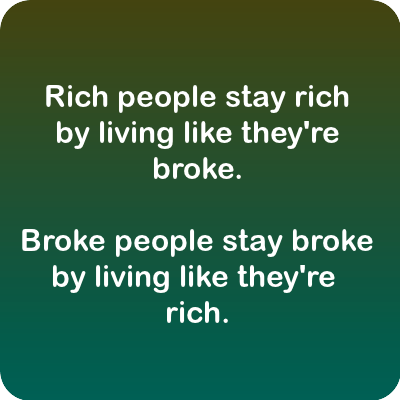
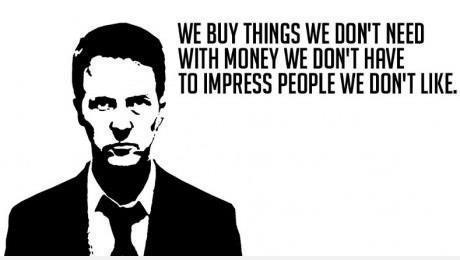
People want to impress people with how money they have and the material goods they acquire.

a6.jpg

For me, the size of someone’s house, the brand of watch on their wrist, or the type of car they drive never impressed me. I always cared more about how someone treats others, the content of their character, and how funny they are (I like to laugh).

These are the type of people I surround myself with.

But often I feel my values are becoming the anomaly in our culture.

Money for many validates them and makes them feel important.  Some look down on others who have less money and revere people who have a ton of money. How we treat people should not be determined by the amount of money a person possesses, yet this has become all too common of a practice in our materialistic society.

We can see our values about money being reflected in who we as society elect to run our country—our beliefs about money, how best to spend it and save it, being central in what political party we tend to be drawn to.

Too often money is the center focus of our life without us consciously recognizing this being the case.

If you look at money to validate you–you are headed down a slippery slope.

Think about the people you love and care for most in your life. I can guarantee you love them for many reasons—none of which being how much money they have.

If money is the sole driver for you–you will in all likelihood drive others away.

I have encountered people whose focal point is money for their validation in life that they would ask outright how much money other people make. They just needed to know to see how they compare that they couldn’t even help themselves but to ask. This is a sign of someone so dependent on money for validation that they need to know where they stand in comparison to others to feel important.

This is not a healthy way to be.

We can see our President espousing his views on money on the daily–stating he loves rich or people but going as far as to say he wouldn’t want a “poor person” in his Cabinet.

People’s views about money are constantly being revealed to us if we pay attention.

Moreover, what is about money that leads to so many problems–psychological and otherwise?

The answer may be found in how we were raised.

Our first messages about money come from our families growing up–often our parents. Whether we grow up in poverty or wealth or in between, we often internalize the messages set forth by our families about money.

Yet there are people who inherit great wealth and blow the family fortune and people who grow up in poverty who amass great wealth.

Some of us follow in the footsteps of our parents’ financial values. Others live in the polar opposite reaction to their parents’ financial values. For instance, if your parents spent too much and lived beyond their means, you may be stingy. You may swing the pendulum in the opposite direction. The reverse can also hold true.

a4

In our country, our economic status is not set at birth (although this is controversial to say–I am sure some people would say otherwise).

Generational wealth and generational poverty does exist.

But what makes someone a saver or a spender?

Two primary motivators seems to drive us–pain and pleasure.

Anything we prescribe pain to we are going to avoid. Anything we derive pleasure from we will move towards it.

Spenders seem to struggle with delaying gratification. They look at spending as a way to derive pleasure. Spenders look at what works for them in the shot-term.

Savers are the ones who sacrifice to save. They look at saving money as a way to avoid pain. Savers have a long-term strategy.

The reality is money influences our relationships. It influences how people treat you. If you are dressed in designer labels, driving around in a Mercedes, you will have a different experience than rolling up in a beater wearing jeans and a tee-shirt.

We all hold views about money and the people who have it. Or don’t have it.

We all have our own money scripts—our core beliefs about money.

I know for me it is important to be financial independent–I would not feel comfortable depending on a spouse, my parents, or ANYONE else for my financial well-being. I would be okay if it was situational (going back to school, after having a baby, etc.) but would not feel comfortable being financially dependent on someone else throughout my life.

This is just my own philosophy. It is okay if you believe differently.  We all have different perspectives on finances and independence. This is why this post is about the PSYCHOLOGY of money—all of our psychologies are different. Personally I think financial independence goes hand in hand with overall independence. Doesn’t make it true for everyone, but holds true for me.

I am aware and respect that not everyone feels that way. We all have our different approaches to life and our finances.

At the end of the day, a change in our financial situation starts with a change in how we think about money.

If you feel you struggle with your finances or it damages the relationships in your life, it may be helpful to seek out a counselor who can help you understand your core values and beliefs about money. You may have subconsciously internalized values that you do not even truly believe from your family of origin.

By seeking counseling and understand how you personally identify with money, you can develop financially healthy habits. If we get a better handle on our money, we can lead happier and healthier lives.

a1


The Psychology of Envy

envy4

Do you find it hard to be happy for the success of others?

Do you gossip about people?

Do you feel extremely competitive with others?

Do you find yourself becoming more and more judgmental of other people?

Do you find yourself comparing yourself to other people on the daily?

Do you find yourself undermining other people’s relationships?

Do you feel happy when you see someone fail?

If you answer yes to any of these questions, you may be struggling with the emotion of envy.

Envy is one of the seven deadly sins and it can be very destructive to your life and your relationships.

Bertrand Russell said, “Beggars do not envy millionaires, though of course they will envy other beggars who are more successful.”

We tend to direct our envy at the people who orbit our social stratosphere–friends, family members, neighbors, colleagues. The reason for this is these are the people we frequently interact with. These are the people we can “realistically” use as a measuring stick to gauge ourselves against.

Most of us would not compare ourselves to Bill Gates but we may use our friend or coworker as a way to gauge our success because we feel we are on a similar playing field.

We cannot experience envy if we are not comparing ourselves to others.

Envy is an emotion we feel when we engage in the social comparison game. Whoever you are envying you believe you are in competition with–yet there are no winners to be had in this game. People who struggle with envy tend to be people who frequently compare themselves to others.

When you compare yourself to another and come up short, you are likely to feel envious.

envy3

Envy is an emotion we all feel from time to time.

It is an emotion that unfolds in a predictable fashion. First, we must face a person with a superior achievement, quality, or possession. Second, we must want whatever this person possesses for ourselves, OR wish that the other person didn’t have it. Finally, we must be disturbed by the emotion we experience when we are in the company of this person.

These type of experiences are available to us on the daily.

Maybe we see a neighbor get a new luxury automobile and look at the ten-year old car sitting in our driveway with feelings of envy.

Maybe a friend gets a new promotion and makes more money then we will ever be able to make in our field and feelings of envy arise.

Maybe our sister travels frequently and often. We can’t afford it and don’t have the luxury of taking time off of work. We begin to feel envious of her.

Any of those scenarios may feel familiar to you.

Unfortunately, the emotion of envy runs rampant in our modern-day society.

With social media, we all get a peek into the lives of others (or at least of the facade they like to present to the world).

Envy is the pain we experience from being confronted by the advantages of others. It causes us to feel anger, disappointment, and resentment.

These emotions turn us against others–and ourselves. Envy truly is a green-eyed MONSTER.

If someone is envious of you, it is not a compliment. They likely hate your guts.

envy 7

Envy is a secretive emotion. Very rarely will you hear someone admit they are envious of someone. To neutralize feelings of envy, the envious person is likely to continually denigrate the target of their envy to anyone who will listen. This works to simultaneously diminish the target of their envy and elevate themselves in comparison.

Envying someone can become an obsession. An unhealthy obsession.

It is a cheap, easy way to give ourselves a boost to our self-esteem–by destroying the goodness we see in others.

It does not matter what the metric you may be using to compare–money, looks, youth, intellect.  You can always find someone worse off than you are IF you are looking for that.

But you will also find someone better than you if you are looking for it.

The reality is there is ALWAYS someone younger, in better shape, better looking, with a better career, more money, better behaved kids, or whatever it is you use as your measuring stick.

Envy is a short-sighted approach to life. We lose sight of the bigger picture.

envy1

For instance, we may envy our friend, who is a doctor–a person with a prestigious career, nice house, luxury car, who travels to exotic places…. BUT we do not envy what it took to get her there: the hundreds of thousands of dollars of student loan debt, the stress of her job, the debt from starting a practice, the cost of malpractice insurance, the years upon years of schooling and residency. We often look at the end result and not all the work or the numerous sacrifices that went into achieving it.

Oftentimes we envy people for things we don’t even WANT for ourselves if we were given the opportunity. Perhaps we are envious of the doctor yet we hate science and math. We would never want to go to medical school and study all the material that is required to BE a doctor. We wouldn’t want to have touch other people’s bodies or be around sick people. Thus we are envying someone who does something for a living we don’t even enjoy nor have a desire to do.

Personally, I could never envy a doctor because I would never want to do what is required to become a doctor.  I would not be willing to be a Bio or Chem major in college. I don’t enjoy the sciences OR math. Would never want to take the MCATS. Or go to medical school. Have to SEE blood. Touch body parts that have not seen the light of day in years. Or deal with insurance companies/HMOs. Or tell someone they are dying from an illness. The list can go on and on for all the things doctors deal with in their profession that I would not be want to do.

When you feel envious, you are often looking at an idealized version of someone else’s life. Not the reality of their day-to-day life.


envy2

What should you do if you find yourself struggling with the emotion of envy?

1)Use envy to motivate yourself. Look at whoever or whatever it is you are envious of. What do they have that you want? Use envy to help you figure out your goals, desires, and values. Do you feel envy when you see a friend’s never-ending travel pics on Instagram? Maybe you have an untapped desire to travel and see the world. Feeling envious when you see a friend in a bikini pic? Maybe it is time to look at your own diet and workout routine. It may be time to work on creating the physique of your dreams. If used appropriately, envy can be a compass guiding us towards things we want in our OWN life.

2)Practice self-compassion. Whatever you feel, don’t be so hard on yourself. Envy tends to arise in someone with a critical spirit–towards others AND themselves. Don’t fight against whatever it is you are feeling but try to engage in these emotions in a positive way. Envy leads to poor decision-making. All emotions, including the uncomfortable ones, are teaching us something about ourselves. We tend to be hard on ourselves for feeling the normal range of human emotions. It is okay to feel envious. However, it is not healthy to act out on these feelings towards others.

3)Start a gratitude practice. Often I have clients start a daily gratitude journal. Envy is counting other people’s blessings instead of being appreciative of our own.  Gratitude helps us focus on all the positive things in our life. Practicing gratitude helps people to be more satisfied with their own life and less focused on others.

4)Reflect on what you feel is missing in your life. If you are feeling envious towards your friend, what is it you feel is missing from your own life? Envy tends to arise from having low-self esteem and feeling unfulfilled. Spend some time reflecting on your goals, desires, and dreams. Is there something in your life that is making you feel dissatisfied? Make a realistic game plan to work towards achieving all that you want out of your life. If you are busy working towards your own goals, you won’t have much time to spend feeling envious of others.

a111

5)Understand your own capabilities. If you are jealous of a singer or athlete, ask yourself if you have the capabilities to achieve what they achieved on that level. I cannot be envious of someone who sings or is an incredible athlete because I am not capable of either.  I am a 100% okay with that because I accept those are gifts I do not have. I find it is more productive to focus on the strengths I do have and build on those. We all have different aptitudes and potentialities.

6)Ask yourself if you really want what someone else has. Are you envious of someone who makes big bucks working in the financial sector but you are risk averse and HATE numbers? This go back to looking at the reality of the life of someone you are envious of. Are you a working mom who when you son gets sick starts to wish you were a stay-at-home mom? Yet when you were on maternity leave you were dying to get back to work because you missed it? We fall into feelings of envy when we forget about the compromises involved in our choices. The compromise we ALL have made in our choices.

Perhaps you have days you wish you could be home with your kids but you enjoy the professional fulfillment of your career and being independent is an important value to you-financial and otherwise. You wouldn’t be happy being financially dependent on someone else or without the ability to use your education and skills. Your kids are also already in school so you wouldn’t be home with them most of the day anyway.

Therefore your envy of a stay at home mom is not what you really want if you were to weigh the pros and cons. You are solely focused on the benefits and not the big picture of what that choice means giving up. This is a common dilemma I hear from women especially as it relates to balancing one’s career with being a parent. Don’t fall victim to the grass is always greener syndrome.

7)Be cognizant of the negativity envy brings to your life. Envy damages and destroys relationships. It creates unhealthy competition. It leads to negative feelings about yourself AND others.

Envious people think life is a zero sum game. They view another person’s win as their own loss. This comes from a scarcity mindset.

Indulging feelings of envy is a road to unhappiness. Have you ever met an envious person who did not seem miserable? Unlikely.

Feelings of envy are likely to lessen as you mature and as you learn to be realistic of your potentialities and accept your limitations.

Try not to worry about what others have.

At the end of the day, we all have our OWN race to run. Comparing yourself to others is a race your will NEVER will and all it will do is SLOW you down on your way to achieving your goals.

envy1 0

envy6

Why You Need Boundaries to Live a Happy Life

41654950_1508409825926967_2680141282981969920_n

Have you been feeling exhausted lately?
Stressed out?
Completely drained?

Ever feel under appreciated, unseen, and unsupported?

If you do, it may be that you need to learn how to set some boundaries in your life and relationships.

Our relationships need boundaries.

Healthy self-esteem=good boundaries=happy life 

The more you love and respect yourself, the more you can love and respect others.

In this day and age, we are living in an increasingly boundary LESS society.

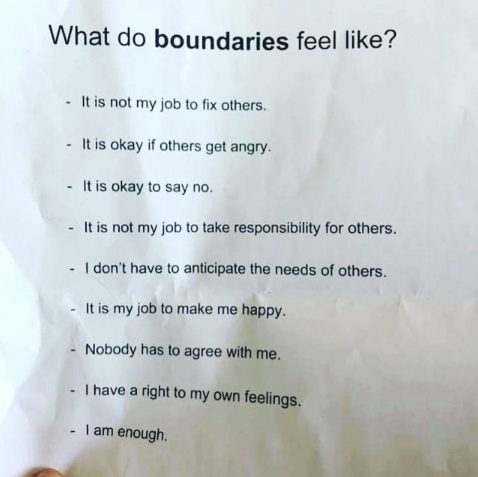
Boundaries, or personal boundaries, can be understood as an invisible shield or fence around you. It’s a line you set for yourself and others that separates you from others and their influence.  Boundaries fulfill an important role in relationships. They are the emotional, physical, and mental limits we set with others that determine what we will, and will not, accept.

We are all separate people but we are also interconnected. Boundaries are the space between.

A lot of issues that arise in counseling, relate to boundary issues in a client’s life.

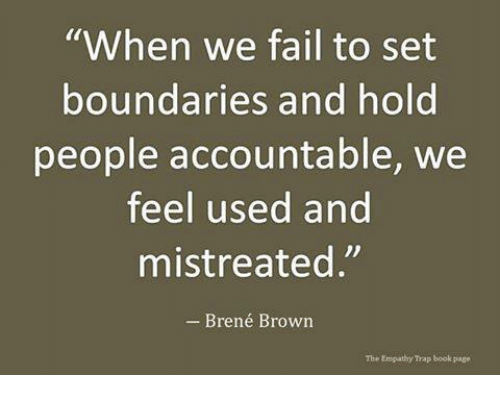
People who lack healthy boundaries are often unhappy. They are more likely to be emotional needy, get taken advantage of, and get treated with disrespect. Boundaries mean not letting people into your life to behave badly.

b1

Good fences make good neighbors.

Boundaries go both ways-you need to extend the same respect to the boundaries of others.

Boundaries give us a framework on how to act. They give us a warning when they are being violated. If someone steps over our boundary, we know it, we feel it, we have a visceral reaction.

Our emotions and thoughts are a compass guiding us–who we want to spend more time with and who we want to stay away from.

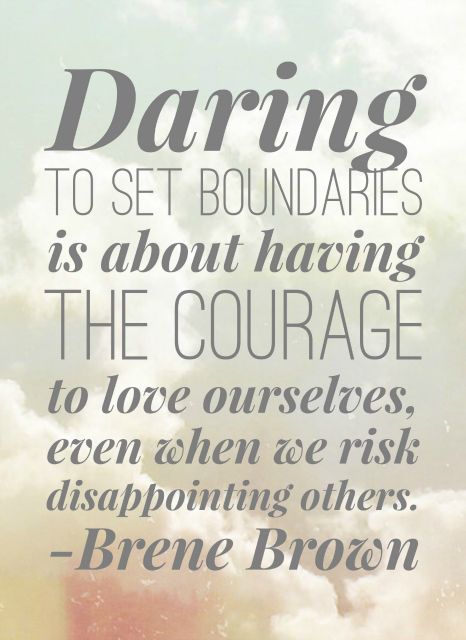
We all have the right and responsibility to set limits and create boundaries that work for us. It is up to you to enforce your boundaries.

You need to value yourself because when we value something we protect it.

b2

What are some signs you have poor boundaries?

~Your relationships tend to be difficult

~You always feel a little bit annoyed

~You think others don’t show you respect

~Your relationships tend to be dramatic

~You hate to let people down

~You feel other people let you down

~You may be passive aggressive

~You have trouble making your own decisions

~You fear being abandoned or rejected

~You are tired all the time

~You have trouble saying no

~You are easily guilted into things

~You coerce others into doing things

~You struggle with anxiety

~You often feel like a victim (especially to situations that you feel are out of your control)

b3

Boundaries are a form of self-care. They don’t steal your happiness, they protect it.

Healthy people have boundaries.
Boundaries are different for everyone—we are all comfortable with different levels of closeness in our relationships.

Boundaries are largely subjective. What I may be comfortable with you, you may be uncomfortable. Neither of us is right or wrong-just different.

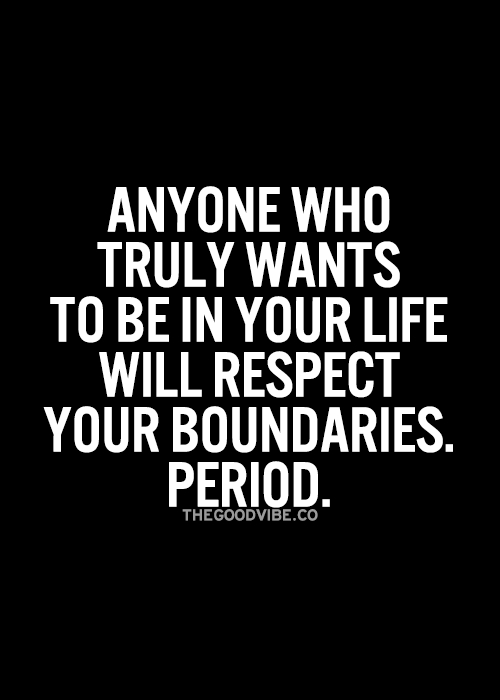
If you set a boundary with someone and they do NOT respect it, they are showing you they care more about their own ego gratification than they do about you and the relationship. If this is the case, while it will be painful to find out, it will lead to greener pastures.

There are two possible outcomes when you set boundaries with people:
~a BETTER, healthier relationship (for both sides)

OR

~you find out the person doesn’t care about the relationship enough to respect the boundaries set forth and the relationship disintegrates (if this is the case you usually feel liberated in the end because you are taking care of yourself)

Ultimately, either outcome, is win-win for you.  Boundaries strengthen understanding and connection between both parties. Healthy boundaries are the cornerstone of happy relationships.

Boundaries are fluid and change as we change.

As someone who is naturally a pretty open book, I have learned over the years to be more private. Perhaps this is a natural progression of maturing. On the flip side, you may be someone who is more reserved, who is working on becoming more open with others.

Boundaries are a two-way street.

Just as we want to ensure people respect our boundaries, it is equally important for us to respect OTHER people’s boundaries.

If you struggle with respecting the boundaries set forth by others, causing conflict in your relationships, it would be helpful to take some time to reflect on why.

Unless there’s an emergency, the one screaming is usually the problem.

There are extenuating circumstances when there’s an emergency or crisis. Or if you are dealing with an extremely toxic person. But if you find yourself flipping out on people, blaming or resenting others for your feelings, the first place to look is in the mirror. You and your boundaries are probably the problem.

If I feel strong in my boundaries and you feel strong in yours, we can meet and connect in a healthy way.

b5

It’s important for our mental well-being to have personal boundaries. They lay the groundwork for how we approach relationships. Our boundaries help us live according to our values.

Clearly established boundaries help us to take care of ourselves emotionally, physically and spiritually. Our boundaries help us to become less concerned about how we are viewed by others and more satisfied with the perceptions we hold of ourselves.


b4

If you enjoyed this article and are interested in seeking counseling with me:

https://www.psychologytoday.com/us/therapists/erin-doyle-theodorou-nutley-nj/243617

Erin Doyle Theodorou, M.Ed, LPC, NCC

THEODOROU THERAPY, LLC

590 Franklin Ave.

Suite 2

Nutley, NJ 07110

973-963-7485

etheodorou@theodoroutherapy.com