Blog

Coping with Mid-Life Challenges

Midlife is a time of transition, reflection, and, for many, a bit of confusion. It’s a phase where the dreams of youth can sometimes feel distant, and the future can seem uncertain. Whether you’re approaching your 40s, 50s, or beyond, coping with midlife involves understanding the challenges that come with aging while also embracing the opportunities for growth, renewal, and reinvention.

In this blog post, we’ll dive into how you can cope with the changes that come with midlife and use this period to rediscover yourself, your passions, and your purpose.

1. Acknowledge the Feelings: It’s Okay to Feel Mixed Emotions

One of the most important steps in coping with midlife is simply acknowledging your feelings. It’s common to experience a range of emotions: nostalgia for the past, anxiety about the future, and even frustration with changes in your body, energy, and lifestyle.

It’s completely normal to go through what is often called a “midlife crisis,” although not everyone experiences it in the same way. For some, it’s a time of questioning one’s life choices, relationships, and career. For others, it’s a moment of deep reflection that leads to a profound sense of self-awareness and growth.

Tip: Start by acknowledging where you are emotionally. Journaling, therapy, or open conversations with friends can help you process complex feelings. Sometimes, just recognizing and naming your emotions can be a powerful first step toward healing and growth.

2. Embrace the Physical Changes: Your Body is Evolving, Not Fading

Midlife often brings noticeable changes in the body—weight gain, wrinkles, less energy, and for women, the onset of menopause. These changes can trigger feelings of loss, but rather than seeing them as signs of decline, it’s helpful to view them as part of your evolution.

Stay Active: Regular exercise can help maintain energy levels, improve mood, and boost your overall health. Find an activity you enjoy—whether it’s walking, yoga, swimming, or even dancing.

Take Care of Your Mental Health: Midlife is a time when mental health can be more vulnerable. Anxiety, depression, and stress may arise, but they can be managed. Meditation, mindfulness, therapy, or creative hobbies can do wonders for emotional well-being.

Nourish Your Body: Focus on a balanced diet with nutrient-rich foods that support your energy and overall health. Also, don’t forget to hydrate and get enough sleep. Small, consistent changes in your diet and lifestyle can make a big difference in how you feel physically and emotionally.

3. Reevaluate Your Career: This Might Be the Time for a Change

For many people, midlife is a time when they start to question their career. Perhaps you’re feeling unfulfilled or thinking about switching paths. Maybe the corporate grind isn’t as appealing as it used to be, or you’ve always dreamed of starting a business or pursuing a creative passion.

While these questions can feel overwhelming, midlife offers a unique opportunity to pivot and pursue something more aligned with your values and interests.

Tip: Take the time to assess where you are professionally. What’s working, and what isn’t? What would make you feel more fulfilled? It could be an ideal time to invest in further education, take up a new hobby that could turn into a side hustle, or even plan a full career change.

For some, transitioning into new professional endeavors later in life can be one of the most rewarding parts of midlife. With experience and wisdom on your side, you may find that you have the confidence to take risks that you wouldn’t have earlier in life.

4. Strengthen Your Relationships: Deepen Your Connections

Midlife often brings shifts in relationships. Your children may be growing up and becoming more independent, or your social circle may be changing as you age. While this might bring feelings of loss, it can also be a great time to focus on the relationships that matter most.

Reconnect with Yourself: During the busyness of earlier life stages, you may have prioritized others—your kids, your career, or your partner. Now is the time to reconnect with yourself. Invest in activities that allow you to grow and rediscover your own needs, desires, and dreams.

Build New Bonds: Seek out new friendships or strengthen existing ones. Sometimes, making new connections with people who share your interests can bring fresh energy into your life.

Nurture Your Romantic Life: If you’re in a relationship, midlife can be a time to rekindle the romance. Whether it’s a long-term partner or someone new, don’t be afraid to invest time in your romantic life and explore new ways of connecting.

5. Find Purpose and Meaning: Reinvent Yourself

One of the most powerful ways to cope with midlife is by finding a renewed sense of purpose. This could involve pursuing a long-held passion, contributing to your community, or focusing on things that truly matter to you.

Volunteer: Giving back to others can be deeply rewarding. Whether it’s through mentorship, charity work, or community involvement, helping others can bring a sense of fulfillment that goes beyond personal achievements.

Travel or Explore New Experiences: You may have put off certain dreams or experiences for years. Whether it’s learning a new language, traveling to a new country, or trying something creative like painting or writing, midlife is a great time to explore new avenues of personal fulfillment.

Be Open to Spiritual Growth: Some people find that midlife sparks a journey toward spiritual exploration or introspection. Whether it’s through organized religion, meditation, or philosophical reflection, exploring deeper questions about existence can lead to profound personal growth.

6. Celebrate Your Achievements and Gratitude

Finally, remember to take stock of all the things you’ve achieved in your life. Midlife can sometimes bring a sense of “time running out,” but it’s also a time to celebrate how far you’ve come. Practice gratitude for the experiences and lessons that have shaped you into the person you are today.

Celebrate your accomplishments, big and small, and recognize the wisdom that comes with age. Reflecting on how much you’ve learned and how much you still have to give can provide a sense of empowerment as you move forward.

Conclusion: Midlife as a New Beginning

Coping with midlife isn’t about avoiding change or wishing for the past. It’s about embracing change, learning from it, and using it as a platform for the next chapter in your life. While the road might seem uncertain at times, midlife offers a unique opportunity for reinvention, self-discovery, and personal growth.

Whether you’re navigating physical changes, career transitions, or personal reflections, remember: midlife is a phase of life, not a crisis. Embrace it as a time to rediscover your passions, refocus your priorities, and find deeper meaning in your everyday experiences.

By accepting the changes, reflecting on what truly matters, and embracing the possibilities, you’ll find that midlife can be one of the most fulfilling and exciting phases of your life.


If you’re navigating midlife yourself, what’s been most helpful to you? Feel free to share your thoughts in the comments below or connect with others who are on the same journey. We’re all in this together!

If you are interested in counseling, please reach out to me:
How Object Relations Theory Can Help You

I often use object relations theory to help clients better interact with the “problem” people in their lives. It’s a complicated theory and I focus on one particular concept that fosters improved understanding of how others operate. This is helpful because almost everyone who comes into my counseling office can admit to having a person in their life they view as a “problem.”

The theory posits that our relationship skills in adulthood are strongly rooted in our early childhood relationships with our primary caregivers, particularly our mothers. Hence why it is often helpful to explore our childhood relationships as they pertain to current relational problems. Sometimes, clients show resistance to looking back in their personal histories, yet often it is required, if we are to effectively move forward in our lives.

A real life application: Have you ever wondered why you always tend to date the same type of person? Or why you always end up having the same argument about the exact same topic again and again with your partner? Or why you are always concerned about what others think of you, even if they are friends who reassure you and treat you with respect? These repeating patterns in relational life are a common occurrence, and many therapists believe that the reason for these patterns is hidden in our childhood experiences.

Often we position ourselves as separate and above in our relationships. We attempt to control our partners, our kids, our bodies, and even the way we think (“I will not be such a Debbie Downer”). Take a step back, and you’ll see that running your relationships from a place of control and power is crazy. Even with that awareness, the minute the emotional temperature begins to rise, more reactive parts of the brain take over, and that is precisely the model we revert to: “I’m right, and you’re wrong. You win, and I lose. I can let you in, or I can protect myself.”

We need a paradigm shift.  Stop a minute and think about people you know and how you feel around them. If you feel seen, heard and valued by someone, they probably have an view of you as a unique, separate person from themselves (good object relations). These people are able to integrate the good and bad aspects of others including themselves. However, if you feel unseen, unheard and devalued, they probably objectify you (poor object relations). These people often are splitters, seeing others as “all good” or “all bad.”

The truth is we can not undo our childhoods, but we can understand them now from our adult perspective. Understanding object relations theory and how it shapes the way you show up in your relationships can be a good first step to more fulfilling relationships. In turn, we can see these relational patterns for what they are deeply ingrained habits, and begin to change them.

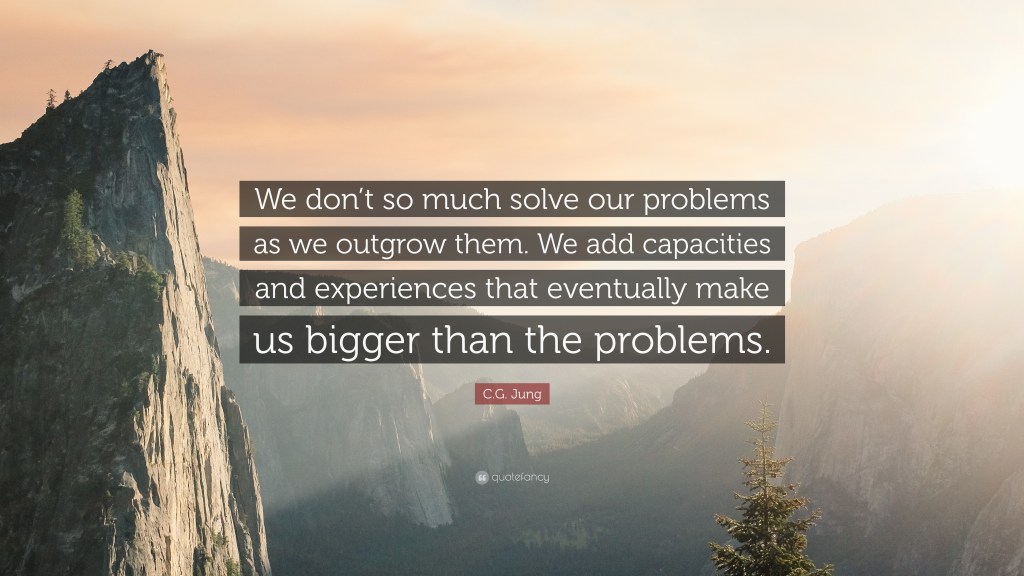
We Don’t Solve Our Problems, We Outgrow Them

I recently read a great quote from psychologist Carl Jung, he said, “We don’t solve our problems, we outgrow them.” As I reflected upon this, I realize how often our attention is spent on trying to solve our problems, instead of developing as a person & outgrowing them. No wonder the problems we obsess on “solving” seem to linger on and on.

And let’s face it-we all have problems. Some big, some small. Some important, some decidedly less so.

The truth is many of the greatest obstacles we face in life, cannot be solved. We must live through them and make it through to the other side, often without solving what troubled us in the first place.

Often times major life events help because they put things in perspective–forcing us to reevaluate our priorities, our plans, sometimes even ourselves. Given this time for introspection, we often realize many of our problems are not problems at all. A mindset shift can work wonders on many “problems” we face in life (why I love CBT!)

Yet one can see, when you spend too much time talking and focusing on the problem (or “ruminating” to use psychology jargon), you get too caught up, and it will be quite hard for you to detach from them, and see the big picture. You will start seeing your problems as being bigger than yourself, bigger than your ability to cope, and you will be overwhelmed; you will have a hard time finding your way out; you will have a hard time outgrowing your problems, and chances are, that you will be outgrown by them.

So stop trying to “solve” your problems. Stop trying to think your way to a solution. Some things in life just need to be lived and eventually, you may find the answer you were looking for along the way.

Important Lessons I’ve Learned Along the Way from Clients

We all face challenges in today’s increasingly complex and demanding world.

The world requires we evolve or fall behind.

Counseling is a journey of personal growth and development. It can help us in every aspect of our lives. Our goals as clinicians are to enable clients with the necessary skills to do this work on their own. The skills we teach are important for managing our emotions and day to day life–educating clients on various coping strategies or how to recognize common cognitive distortions in their self-talk. Clients learn how to set reasonable and appropriate boundaries in trying relationships. Others learn to cope with painful emotions and emotionally regulate. Some clients discover how to accept themselves or to accept other people in their lives as they are, i.e. how to manage their expectations of self and others. Yet the truth is counseling is a learning experience on both sides of the equation as clinicians also learn from their clients.

One of things I value the most about working in this profession is the great privilege and honor to be in the position to reap wisdom from my clients. Over the years, the work I have done with people from all walks of life, has led me to grow, both personally and professionally. Learning from the experiences of others is inherently valuable. Being able to listen to people’s deepest thoughts and hear their most vulnerable feelings leads one to the understanding that we all share many more commonalities than differences.

Below are a few lessons I’ve learned over the years — lessons that’ve influenced how they I approach my role as a counselor.

Prioritize Your Mental Health Just as Much as Your Physical Health

Our mental health impacts every aspect of our lives. We often think of our body and mind as separate but they are interconnected. Physical health problems significantly increase our risk of developing mental health problems, and vice versa. Our mind is very powerful. It literally has the power to control how we feel, act, and behave. Sometimes we have habits that contribute to our own suffering. Counseling can bring awareness to how we contribute to our problems and how to change. The fact is our mental health impacts everything we hold dear– from our relationships with family and friends, to our careers, to our physical well-being, to how we show up for ourselves & others in day to day life.

The story you tell yourself impacts how you feel about your life.

Our self-talk is pivotal to the quality of our lives. A client can be functioning fairly well, but if they aren’t inspired by their job and feel disconnected from the people in their life, they can feel depressed. How one assigns meaning to different aspects of their life will have a profound impact on how they feel. We must be mindful of the stories we tell ourselves about our lives and the people in them.

Clients do well when they want to.

I can’t change a client. I am not there to “fix” a person who is seeking out counseling. I am the facilitator of growth and change but it is up to the client to take ownership of their own life.

This experience taught me two lessons: I shouldn’t be working harder than my clients; and there’s only so much I, and anyone else, can do to help another person.

Ultimately, it’s up to them whether they choose to be well or not.

Life is a gift.

Having counseled countless clients through grief and loss, one blessing of this work is the awareness of the preciousness of time. I also realize far too often we are left with unfinished business when people in our lives pass. Far too often we get caught up in the petty minutiae of day-to-day life and fail to see the big picture. Don’t sweat the small stuff.

Staying Anchored in the Present is Important to Good Mental Health

Many clients struggle to stay in the present moment. It is a struggle I have experienced as well. We as a species tend to ruminate over the past or project ourselves into unknown future and fret over it. Hence why so many people suffer from anxiety or depressive disorders.

I realize now that it is as if in life, the needle sets on a record album the moment we are born and continues to cycle as we live. If we bring our awareness to the past or to the future, we scratch our record and there is no music. If we stay in the present moment, we hear the beauty of our song.

Because I have seen clients go through many tragedies, I try to live every day with a sense of wonder and appreciation. Some days it is easier than others. Therein lies the truth.

Life is full of uncertainty, and offers no promises, so live each day without a sense of entitlement, treating it as a precious gift.

You can’t change anyone.

I am reminded of this lesson every day in my work and in my life: You can make a lifetime project of trying to change someone, but until they decide they want to change, your efforts will be futile. The only person you can change is yourself. That’s why I focus on “being the change that I seek.”

Perhaps this means ending an unhealthy relationship. Maybe it means changing the role that person has in your life. Or it can mean reframing how you view the other and the relationship as a whole. There are no black and white answers to nuance, complicated relationships. Sometimes we have to accept there are no ideal answers yet we are challenged to make the best of it.

Connection is key with clients.

The therapeutic relationship is paramount. I have learned the importance of understanding, compassion and connection for working with his clients.

When I was starting out, like so many others in a “helping profession,” I wanted to fix others and make them feel better. That is not the role of a therapist. Allowing others to struggle and make sense of their own lives can be hard to bear witness to as I often wanted to jump in and save them from these painful emotions. Part of the process of genuine, authentic therapy is discomfort. I would be robbing clients of their growth if I didn’t allow them to experience the whole spectrum of emotions that come up in psychotherapy. It is important to have faith in the process.

As a clinician I need to know the disorders, treatments, and techniques, but many clients feel helped most when I’m able to put all that aside, pay attention to how they feel, and just be with them in their grief and pain. Theory and technique matter, but a genuine human connection matters more sometimes. Through that caring connection they feel empowered to do the work they need to do.

Authenticity is key.

It is a privilege to work with clients because often they are sharing intimate aspects of their lives that they have shared with no one else. Remember we are collaborators and conduits to problem solving. Thus we must be authentic in our responses to clients’ thoughts and questions. A client will pick up if you are genuine or not. I have learned to always be myself–whether that will be a good fit for the client or not. During the first session I will tell clients effective therapy requires a therapeutic alliance. A client needs to feel a connection to their therapist and not every therapist is for every client. It is important to find someone who is a good match for you, even if that person is not me.

People have a vast capacity for courage, love and forgiveness.

I routinely work with clients who have been deeply wounded by parents, siblings, or friends, yet they demonstrate open-heartedness in their willingness to forgive and preserve love.

Seeing clients’ resilience, humanity and courage have helped me put into perspective my own emotional grievances, and move toward love and forgiveness.

I Don’t Know What I Don’t Know

It is okay to not have all the answers. No one does. We can try to figure it out together.

Through my work with clients, I have discovered every clinical relationship and each session provides opportunities to view life, the world and the human experience from the eyes of another.

The Best Way Out is Always Through

We all have faced a situation that seem insurmountable at one point or another in life. Some problems are insoluble. Some situations a struggle through a dark forest where there is no path and no light to guide you.

Which is why I remind you as Robert Frost so eloquently stated….

The best way out is always through.

As a therapist, sometimes my job is to be with my clients as they “get through.” Which I take to mean looking at one’s situation in a cold hard light. That can be hard to do – but necessary. Because we all are capable of deluding ourselves by telling little, white lies. These lies can come in the form of:
It’s not that bad.
It’s not my fault.

That wasn’t my “intention.”
Things will get better without me changing…if I can just wait it out.

Do any of these sound familiar?

Through careful and meaningful counseling, I work with my clients to strip away the falsehoods and look reality in the face. The work is not always easy. Counseling can be very uncomfortable. Yet when one begins to come to the realization the best way out is through, it’s good to have someone there to urge us on with encouragement and support – knowing that we are not alone. This is the gift of therapy.

Only by being honest and true, can we take a full assessment of our lives and then begin to make real and concrete changes. If we don’t, we end up just doing what we’ve always done and getting what we’ve always gotten.

Life’s too short. Change and personal growth can be difficult. But the alternative is stagnation. And a stagnant life can be full of depression, anxiety, fear, anger, etc.

Thus it is time to ask yourself: are you ready to make is through to the other side?