Dysfunctional Families: Who They Are and How to Overcome Yours

dysfunction 2

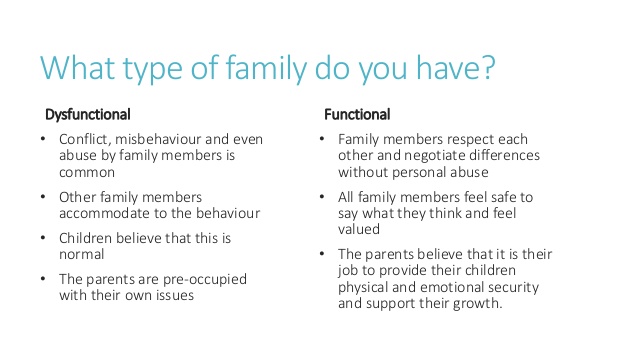
Ever wonder if you were raised in a dysfunctional family? There is no real guide to determining if a family is categorically dysfunctional, but here are some questions to ask yourself:

~If people tell you that you are like your mom or dad do you get upset and hope it is not true?

~Do you have a history of struggling with depression?

~Do people in your family always “react” to the choices of other family members? Dramatic reactions in fact?

~Have you said something hurtful (or many hurtful) things to someone in your family and wish you could take it back?

~Is your family quick to blame?

~Do you feel guilty standing up for yourself?

~Have people in your family said things to you that were just plain cruel?

~Do you feel angry often?

~Do you constantly people please?

~Are you a perfectionist?

~Do you struggle with your self-esteem?

~Do you self-medicate? Alcohol, drugs, food, sex?

~Is your family judgmental and critical of others?

~Do you relate to others with dysfunctional families? Alcoholic parents? Divorced parents?

~Is your family competitive with each other?

~Do you believe you will be (or are) a better parent than your parents?

~Is there on-going conflict in your family? With different members? Across the different generations?

~Do you struggle with anxiety?

~Is it hard to communicate in your family?

~Does it feel like there is a hierarchy within your family? Where some members are more important than other members?

~Do family members gossip about other members? Lots of third-party conversations?

~Growing up was your home life unpredictable? Did you move a lot? Switch schools frequently?

~Do you feel afraid to disagree with your family outright because risk of rejection?

~As a kid, did your parent feel more like a friend than a parent?

~Does your family hate change? Are new members welcomed in? Are adult children encouraged to be independent?

~As a kid, were your parents overly strict? Overly permissive?

~Is there a lack of diversity in your family? Are differences of opinion tolerated?

~Do you fear being abandoned?

~Did one (or both) of your parents leave you as a child? Physically or emotionally

~Is it hard for you to trust others?

These are just some possible signs of dysfunction in the family system. You may relate to some, none, or many of the aforementioned questions. Dysfunction exists on a continuum. If you relate, don’t feel too bad–most families have some level of dysfunction inherent in them– which is usually passed down from generation to generation.

Nobody comes from a perfect family.

Yet in dysfunctional families, every member has a role. The rescuer, the victim, the persecutor. For every rescuer there is a victim. For every victim there is a persecutor. So starts the triangulation of these “roles.” Dysfunctional families frequently engage in triangles.

Triangulation is when instead of members talking directly with each other about problems, they bring an outside person in to intervene in a conflicted or stressful relationship, in an attempt to ease tension and facilitate communication.

Let’s say brother A tells brother B he would like brother C to help out more with their sick father who needs a lot of day-to-day assistance at home. Dad is getting older, with more severe health issues, and can use all the support he can get from ALL his sons. When brother B goes back to brother C and gives the message, then brother C will wonder why brother A didn’t just come and ask for himself.

There is always a manipulation tactic within triangulation. Brother A might not like to ask brother C or he might know brother C will say no so he hopes brother B can be more convincing than he was when he asked the last week. Or maybe brother A realizes the only way to get brother C to do what he wants is to put familial pressure on him. When both brother A and brother B ask brother C, then brother C might feel even more pressure to comply.

Dysfunctional families triangulate to coerce other members to do things they rather not do. They also use it as a way to manage conflict. People who triangulate will call this “venting” but the healthy way to deal with conflict is to talk about it directly with the person you are having conflict with. The problem with triangles it is usually prevents, rather than invite, the resolution of conflict.

Venting and complaining about family disintegrates all three relationships within the triangle. Trust fades for someone who talks about others behind their backs. Respect also lessens for someone who listens complacently to endless fault-finding.

dyfncutin 5

Triangulation is also extremely unhealthy when children are involved. The wife who confides in her young son about the troubles in her marriage. The father who shares his worries about finances with his tween daughter instead of speaking directly to his wife.  In dysfunctional families we often see parentified children-where the child is expected to act as the parent and the parent acts like the child. The oldest child may help his siblings off to school, makes lunches, helps with homework because the parent, for whatever reason, is unavailable–whether physically or emotionally. Often a parentified child acts like parents to his OWN parents. The parentified child usually takes on the role in an attempt to keep chaos at bay and keep the family unit functioning and together. Later when the parentified child grows up they usually pick a spouse who is dependent–so they can continue to play this role of parent to their spouse.  This is a clear example of boundary problems and unhealthy roles within the family system.

Another common problem in dysfunctional families is the lack of self-differentiation. Murray Bowen, who is the father of this concept, made it one of the cornerstones of family systems therapy.  Self-differentiation has two tenets: that you are able to separate your feelings from your thoughts AND you are able to distinguish between your experience and the experience of those you are connected to.

Being self-differentiated is being able think for yourself and act according to your own values. When you are self-differentiated you able to disagree with the choices of a family member without trying to get them to change.  The less differentiated you are the more impacted by others’ thoughts and opinions you will be. A highly differentiated person can maintain a solid sense of self even under considerable stress and anxiety (Bowen). People who are self-differentiated are not reactive and are able to make decisions independent of the input of others. At a lesser level of differentiation, a person is dependent on the input of others to make decisions and function. A person with a low-level of self-differentiation will exhibit many symptoms of stress and often act destructively under pressure. Even intelligent people can be poorly differentiated (Bowen).

When you are self-differentiated, you still care about your family and want to be connected to them. Yet you are able to limit the chaos and are not be enmeshed with your family. Enmeshment is when you are defined by the family system and look to it for your happiness rather than to the outside, larger world. When you are enmeshed, your sense of identity is wrapped up in your family. You are not able to recognize where you end and they begin. This psychological boundary does not exist in dysfunctional families.

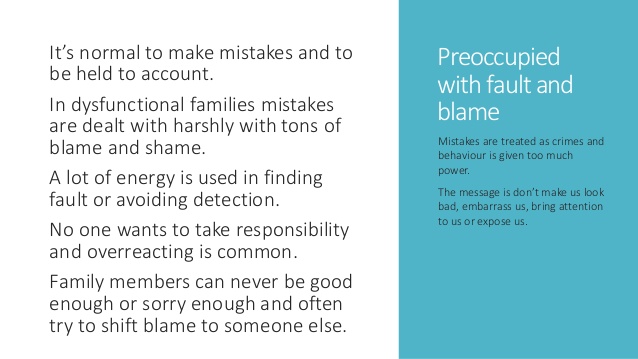
In unhealthy family systems, it is hard to differentiate because differences are not tolerated. If you are conservative and your family is liberal you are mocked. If your family is athletic and you rather read than play a sport, you are teased.  If Christmas is always at sister Susie’s and you want to have it at your house, you are met with resistance. Change is not welcome in dysfunctional families-of the individual or the system as a whole. In this type of family differences are not celebrated. Lots of shame permeates the family system.
dsyfunctiona 1

In dysfunctional families, members are made to feel guilty if they don’t visit enough, call enough, come home enough.  In such families, alliances are often being formed. These alliances are ever shifting. Alliances form because members are expected to choose “sides” on every issue. In healthy families, members don’t gang up on others, pick sides, or insert themselves into conflict between other members. These are all symptoms of an unhealthy family system at play. Remaining neutral in the face of conflict is a sign of maturity and self-differentiation.

For example in enmeshed families, there tends to be a lot of drama because everyone feels entitled to opine and react on the decisions of other members. For example, son A decides he is going to move across the country for a job. In an enmeshed family, the parents may take this as a betrayal and personal affront. They may feel he is abandoning the family. Mom and Dad share their hurt and disappointment with son B instead of sharing how they feel DIRECTLY with son A.

Therefore, son B may pick a fight with son A to express his disapproval and as a way to align with the parents. Son B and the parents are forming a coalition to try to impede son A’s decision to move away. When Son A responds in a level-headed, non-reactive way to his parents and brother, calmly stating why he is choosing to move, he is met with anger and rage. His parents and brother take his calmness and composed demeanor as a sign he does not care or love them.

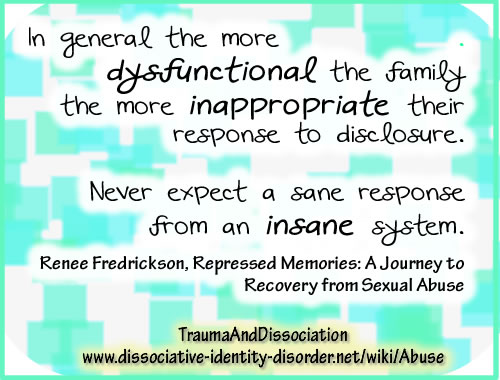
In unhealthy families, chronic anxiety exists. When you self-differentiate and are non-enmeshed you are much more relaxed and calm. This is viewed as a threat to other family members who are still in a state of enmeshment. In toxic, immature families becoming more mature, less reactive, and less anxious is viewed as you don’t care, you don’t love me, you are cold.
dysfunction 2

The blurring of self is normal in a dysfunctional family. If you come from a family riddled with dysfunction, the idea of personal boundaries may seem foreign to you. You are used to living in a bondary-LESS environment.  A person’s willingness to accept your boundaries and limits show where their level of respect is for you AND how emotionally developed they are. In a dysfunctional family it is hard to negotiate with other members the amount of separateness and closeness you feel comfortable with because compromise is not something rigid family systems can do.

Dysfunctional families can be cult like. Oftentimes family members are not even aware of the dysfunction or in denial about it. Things are never discussed. Third party conversations run rampant. Direct communication does not exist. Expectations are never questioned. It is just the way it is.

All dysfunctional families want to maintain the status quo. This is what we always done, this is what we will always do is the family motto.

How to Begin to Differentiate from Your Family

1)Uncover your family’s rules and paradigm.

2)Ask if you believe the rules you have been following blindly since childhood. Children follow their parents unquestioningly, adults do not. It is appropriate when you are the child to look to your parents to affirm your identity. As an adult, this is unhealthy.

3)Stop needing your family for things they can’t provide. The mother you never had. The father you always wanted. It isn’t going to happen. Stop waiting on this. The sister you always wanted to love you a certain way–who doesn’t, can’t, won’t.  This is a time to begin the acceptance process.

4)Reflect on what YOU believe. YOU. Stop handing your emotional power over to your family. Be who you want to be not the role your family expects you to be.

5)Understand guilt, shame, and transference of anxiety is NOT caring. It is the norm in dysfunctional, undifferentiated families. Stop holding onto these feelings-it only revictimizes you.

6)Resist the urge to rescue others.

7)Do for yourself what your family could never do for you.

8)Be mindful. This is not about blaming your family. This is about acceptance. This is you being you while being connected to your family. This is not about disconnection. This is about healthy connection.

Accept while you may have changed that we can’t change others unless they want to change. This is a time of opportunity for you. Instead of perpetuating the cycle of dysfunction, you can change the future—when it comes to breaking the cycle with your children and the next generation.

healthy-families

The Psychology of Shame: How It Destroys

When was the last time you felt shame? Maybe you were embarrassed in front of your boss, or you felt guilty because you didn’t get done what you promised. Perhaps you can think back to being a child and being told, “Shame on you!” Or another classic version, “You SHOULD be ashamed of yourself!” Whatever it was, you’ll remember it wasn’t a good feeling.

Shame can be a way to teach lessons that we think someone needs to learn. Naturally during childhood, it is commonplace for the adults in our lives, such as our parents and teachers, to teach us lessons about right and wrong. Times were different a generation or two ago. Children were to be seen not heard. These adults likely meant well, but may have used shame to try to teach good values, not realizing they were instilling the genesis of inadequacy. We now know, from years of research, that shame is not an effective way to implement a change in children’s behavior.  You are bad, you are stupid, why can’t you be like your brother. These types of messages hurt and are ineffectual.

If we can see that shame is not effective in modifying children’s behavior, we must be mindful that the same holds true for adults. You see in life many things bother us- people most of all. Our natural response to this is to blame the other person and try to fix it. And by “fix it” this usually means change THEM (not try to change ourselves because YEAH, RIGHT).  We  attempt to alter the person into something we consider “right” or at least something that will not bother us. Thus you can see how we all, consciously or unconsciously, try to influence how others in our world behave.

Having “influence” is commonplace in politics and the professional world. Perhaps you have even read Dale Carnegie’s “How to Win Friends and Influence People.” Trying to exert influence is a very real factor not just in our professional relationships but our social relationships.  We all remember as teens having the one friend our parents referred to as a “bad influence.” Nowadays, as the case may be, you recognize yourself trying to “influence” your husband to eat better. Or maybe when you try to “influence” your kids to get their homework done. Or being the friend who tries to “influence” your other friends to go to the gym (and skip happy hour). Maybe you’re the son who tries to “influence” your mother to get an in home aide to look after her. In both direct and indirect ways, we all are trying to be influential in our own right.

The reality is we all want some level of control over our lives and to be influential in the lives on those we surround ourselves with. Whether we try to use our influence for good or bad is up to us.  There are many ways we try to exert influence. Shame can be a tactic people use to influence the behavior of others. It is also the base of most destructive behavior.

The experience of shame is universal. It is a powerful state of being. We all have experienced “shaming” behavior in our day-to-day lives.  The boss who says they are disappointed in our proposal. The friend who said they would never wear that. The waitress who says they can’t believe you can eat all that (this one actually happened to me–I CAN eat all that and I did!) The thing about shame is it is not really an effective way to influence behavior. Shame can only work if the person truly cares what we think of them.  Thus shame may work with our spouse but it will not work with our coworker who can NOT care less what we think of him.

We all to a lesser degree have been on the receiving end of shaming behavior Many times it is innocuous in the way it is meant or delivered.  The waitress, the friend, or your boss may have meant nothing malicious by it. Yet shaming is also a technique used by abusive people to distract from their own bad behavior.  Perhaps you experienced toxic shame before– someone belittling your achievements, ideas, efforts.  Trying to make you feel less than just as you are. As a clinician, I see shame as being a common abuse tactic experienced by clients, many who have survived abusive relationships. All types of relationships can be abusive not just romantic relationships. In hearing the stories of those who have struggled with this form of abuse, it has shown me how abusers often rely on shame, as a tactic to keep victims down. Shame can be an attempt to silence people who are not strong enough to stand in the strength of their voice.

Brene Brown, who has done extensive research on shame, has called it a silent epidemic.

shame 2

The truth is shame has the potential to be one of the most painful emotions we can experience. Shame is not that something you did was bad. Shame is you ARE something bad. Inferior. Inherently flawed. Less than.

When someone tries to make you feel like you should be ashamed of yourself, they are expressing contempt.  Shame is a way to diminish another.  It is a way of showing the shamee that to destroy you is a non-issue.  Thus when someone is trying to tell you shame on you what they are REALLY saying is shame on me. Because when someone tries to shame you, they are trying to transfer their hurt and pain onto you. Shamers are projecting their OWN shame, their own painful emotions. Attacking another is a way to disown the uncomfortable feelings they are experiencing. Abusers do this often to people they perceive as weaker. Unless you have a developed, strong sense of self it will be a struggle to not OWN the STUFF being thrown at you, when someone is offsetting their pain.

(Keep in mind,  we often shame ourselves–different post with more on that to follow).

There are many ways we try to shame OTHERS–teasing, eye rolling, name calling, sarcasm, yelling, expressing disapproval. Some people even resort to public shaming-to humiliate their victim to others—online posts, group texts, Instagram pictures—the Scarlet Letter-ing of our time. This type of behavior is extremely common during the adolescent years but still prevails amongst adults who have not developed passed an adolescent on an emotional level. Such behavior gives the shamer a feeling of superiority and communicates to the shamee a sense of unworthiness.

Anyone who is trying to shame you is not open to communicating with you in any real or meaningful way. The shame game is a way to manipulate and punish.

The only way to win in these situations is to not play.

shame 5

As a therapist, I have witnessed the powerful way that shame can fuel rage in children and adults alike. Whether this anger is directed outward at others or inward at oneself, this anger can act as a distraction from experiencing shame and the feelings that come along with it. Often when triggered by shame, we feel other self-conscious emotions such as discomfort, inadequacy, guilt, embarrassment.

Many of us can shake off the feeling and keep it moving. But others find it incredibly difficult, and it affects how they turn out.

Shame may work in the short-term but it comes with more detriments than benefits. It will hurt the relationship between the shamer and the shamee in the process. Being shamed causes us to lose respect for whoever OR whatever it is shaming us. Shame is at the root cause of many relationship problems. 

People who try to shame you are trying to get what they want at your expense.  Shame is a way to try to control others, by trying to trigger their need for connection, with the threat of disconnection. Such behavior is designed to get you to act according to someone else’s rules. Shame is a way of shutting the other person down.

The sad thing is there will always be people who try to shame you.

No matter what you do right or wrong, you don’t deserve to be humiliated or made to feel ashamed. If someone wants to make you feel this way,  recognize you are not dealing with a healthy person.

It is natural for decent people to find certain behavior unimaginable. You can’t imagine anyone can act in such a manner or say such a thing. Shame can be good in this sense–it is the “I couldn’t live with myself if I acted like that, did that, thought that” feeling.  Healthy shame is necessary.

Underneath shame there is a desire to be heard, validated, understood, and loved. On a continuum shame is at one end and feeling supported at the other.

Shame is not a productive emotion. If we are empathetic people we usually do not want our words to cause harm. Words are powerful. They can build up our relationships with others. Or tear them down. I have a sign in my office that says:

“Think before you speak: Is it….true? Is it….helpful? Is it….necessary? Is it….kind?”

Here’s to the practice of being mindful of our words BEFORE speaking them.

shame4

Why We Love to Procrastinate

If you were to ask people what their worst habit is, of all the bad habits they may have, procrastination is usually up there at the top. Procrastination is postponing an unpleasant task to our future self. Who amongst us hasn’t been guilty of indulging in some procrastination?

Ironically enough, for the last few days, I have been procrastinating writing a post on procrastination.

I did all my go to ways to procrastinate–I went out with friends after work (love distracting myself with others), caught up on my DVR (it was calling my name), I scrolled through Instagram to see what other people were up to (sadly, I even got distracted by watching tv and lost my place on Instagram–had to start all over from the top of my feed-I hate that).

Procrastinating goes against our best interests. It is not logical. Even with the best intentions set many of us find ourselves unable to follow through.

Even when I finally start what I set out to do–I easily find ways to distract myself. I text, watch a few YouTube videos, sometimes, I even go stand in front of the fridge trying to decide if making something to eat is a good idea. Maybe now, I think to myself, is the opportune time to organize my junk drawer.

To be honest, this post would probably be better if I hadn’t waited until the last-minute to get to it.

But right there lies the beauty of procrastinating.

See when we wait until the last-minute to do something, we are able to give ourselves, a built-in excuse for why it doesn’t turn out so good. It’s not that I am a horrible writer, I have just been so busy with other things, that I couldn’t give it all my attention and effort.

This type of thinking serves as a way to give ourselves a buffer for criticism and failure. If I procrastinate working on something that I am worried may be above my abilities, I create an excuse for myself when it doesn’t turn out well.

Procrastinating is a great way to protect our ego and self-esteem.

We can see procrastination easily in others–the kid who don’t study or hand in their homework, the friend who never gets around to using that gym membership that cost a fortune, or when our partner puts off his to do list of what he needs to get done around the house.

Everybody procrastinates.

This tendency–to avoid taking action—is prevalent amongst all corners of the world.

It can be harmless to procrastinate depending on the task at hand. I can say for as long as I can remember, I put off doing my laundry until the last possible minute (running out of clean towels and I really want to re-wear something from a few days ago seems to get me moving). This isn’t going to really affect my life in any real, meaningful way. When push comes to shove, it gets done.

But people procrastinate not just tasks, but goals. I can’t tell you how many diets I put off to Monday, only to put it off to next Monday, only to put it off to next month…(I feel I am not alone on this one).

We avoid going to the gym, asking someone out on a date, tackling difficult assignments, apologizing, starting a new business, asking for help.

Maybe we procrastinate checking out a mole on our arm.  We put off difficult conversations to avoid conflict. We delay big decisions like switching careers or getting a divorce.

Procrastinating important goals–such as saving for retirement or quitting smoking–can lead to more serious problems.

The list is endless of what we can and DO procrastinate.

People will procrastinate until they run out of time.

But why, you may be asking, do we do this to ourselves?

We procrastinate because we are avoiding discomfort. We just don’t feel like it.

Procrastination is a misplaced coping mechanism.  It is an avoidance behavior, usually what we are avoiding, is PAIN. Whatever action we are avoiding involves some sort of pain-whether physical or emotional.

Procrastination keeps us from doing things we don’t want to do. Does anyone want to put away 20% of their paycheck for retirement when there is a long list of other things that money can be used for? Does anyway want to eat broccoli and cauliflower when there is a bowel of pasta sitting in front of them? Does anyone want to go for a run instead of relax on the couch after work?

We procrastinate because it is easy. It is easy to put things off. It is hard to break out of your comfort zone and build momentum. When we procrastinate we avoid the negative, unpleasant feeling of action and get to indulge in the comfort of INACTION. We put off going to the gym and opt to instead scroll the internet creating Pinterest boards of recipes we all know we will never make. We rationalize to ourselves why today isn’t the day.

Many of us will do anything to get us out of the unpleasant task of something we don’t feel like doing.

Procrastination is all about feelings. Mainly avoiding unpleasant ones. Even when we know better. Yet our desire to procrastinate can seriously affect our life.

Imagine a task you have been avoiding. Picture starting that specific action in your life RIGHT NOW. Try to fathom how you will feel.

The painful feelings you are avoiding can be fear, vulnerability, embarrassment, insecurity, anxiety. These are all forms of emotional pain.

We don’t procrastinate things we enjoy. We procrastinate things we view in one way or another as uncomfortable.

To overcome procrastination, we need to realize we are avoiding pain and that soon we ALL have to face reality. Eventually we have to–check our bank account. Get on the scale. Go to the doctor and find out what is really going on. Answer to our boss. Answer to ourselves.

You can only avoid reality and responsibility for so long. Your future self will not be any better equipped to take on a task that your current self is avoiding. Human nature, being what it is, likes to retreat to our comfort zone and stay there.

The price of our comfort zone is a shrunken world. We miss out on relationships, opportunities, experiences, all which will pass us by. Staying in our comfort zone keeps us from truly living a full life.

Our time is limited. When you procrastinate, you waste your time. Time, the one thing you can never get back, no matter who you are.

Start thinking about the future you. The you, who will thank you for getting the ball rolling, today. Not tomorrow. It is time to shift your mindset to thinking about down the road, not just for what you want in the moment.

My favorite piece of advice was from a teacher I had who told me to JUST get STARTED. Give yourself ten minutes on any task you are putting off. You will be surprised the type of momentum you get from just BEGINNING.

Remember you will never feel like it. Stop waiting until you feel like it. Feelings have a way of holding you back.

To change, you HAVE to take action.

We can prevent procrastination. It is a habit and like all habits it can be unlearned. Rip off the band-aid and feel the discomfort and stress, that you will eventually feel later.  Be willing to suffer through the feelings NOW to feel better later. The best feeling will be the results experienced by your future self-when you feel accomplished and able.

The bottom line is procrastination is just a feeling. 

There is nothing stopping you. Except you.

It is time to stop allowing yourself to be ruled by a feeling that brings with it so many negative consequences. It is time to stop letting yourself off the hook.

Can you imagine how much less stress and frustration you feel if you just make yourself do the things you don’t want to do, when you are actually supposed to do them?

Time for me to heed my own advice.

I am going to go now. To take a walk. Even though I don’t feel like it.


Are You Putting Your Happiness on Hold? How the Arrival Myth Will Ruin Your Life

Have you been putting your happiness on hold?

Are you waiting on your life circumstances to be just right to finally feel happy?

The concept of the arrival myth is that once you have “arrived” at a certain point in your life, everything will fall into place, and the life you have ALWAYS wanted will begin.

Tell me if any of these sounds familiar:

“Once I am finally in the right relationship…..then I will be happy

“As soon as I get out of debt…. then I will be happy

“Once I am done with school….then I will be happy

“When I lose those 30 pounds…. then I will be happy

“Once my kid gets into college… then I will be happy

“As soon as I get that raise… then I will be happy

“When I finally leave this horrible job…. then I will be happy”

~And the list goes on and on. ~

We put our happiness off to the future to AFTER we reach some future, external goal or event.

The myth of arrival leaves us believing that once we get to this certain point; our life will magically FEEL better. Because that is what the arrival myth is all about. How you feel.

For me, putting my happiness on hold until I reach some external goal or event seems like a surefire way to wake up on my deathbed never having experienced being happy. Human nature, being what it is, we are always going to keep moving the goal post.

There is also no way to ensure that the thing we are wishing for will even have any effect whatsoever on our happiness. This sets us up for pain, when we reach the goal we so longed for, and the happiness we were expecting, never comes.

Imagine losing 30 pounds and still feeling just as depressed…

Imagine having your kid get into their first choice college and still feeling just as anxious….

Imagine getting that huge raise and still feeling just as lonely…..

The reality is accomplishments don’t take away our depression OR anxiety OR our loneliness. Our life will not suddenly be all sunshine and roses once we reach our goal. The myth of arrival has to be one of the most happiness stealing mindsets around. It is common, so part of being human.

This type of thinking keeps us so focused on the destination, we cannot enjoy the journey.

Don’t be that person. Try to be happy. NOW.  No matter what the circumstances of your life are—don’t wait for the new job, new house, new partner, new location, new body, new income to experience joy.

Try not to allow your current circumstances make you long for a past that cannot be recovered OR put your happiness on a future event that may never come.

Remind yourself there are many people worse off than you in this world. We all know the common phrase “first world problems” which is something I think to myself when I am indulging in complaining or feeling like I got the short end of the stick in any given situation.  I tell myself that my problems really are NOT problems in the big scheme of things.

If you have your health, food in the fridge, a roof over your head, you are luckier than many who walk the Earth.

Remember you can always lose all the blessings you do have at any given moment.

Human nature is to take things for granted.

The extra 10 pounds you complain about don’t seem all that bad until you lose the job you support your family with. Then the job you complain about doesn’t seem all that bad, when you realize how hard it is to find a new one. See where I am going here? For some reason, as humans, we love to have problems to complain about to keep us from experiencing peace and contentment. If we don’t have any, we will create them. Reminding yourself things can ALWAYS be worse can help you appreciate all the imperfect but good things you do have.

Do not place your happiness in some future that may never even come.

Stop letting your current life situation steal your happiness, which you can be experiencing now.

Chances are, your life, is pretty great just the way it is.

Are You The Problem? Here’s How to Tell, and How to Change


There is no good way to say it…but sometimes the problem is YOU.

Rarely if ever, when you ARE the problem, do you realize it.

But maybe, just maybe, the problem with your life is you if:

*You push too hard to get your way.

*You think only one opinion matters-yours.

*You barely have any friends, and the friends you do have, are not very close friends.

*You are older than 5 and still yell. Or scream. (bonus point if you do this in public)

*You expect people to do as you say. Period.

*You can’t keep long-term relationships.

*You worry so much what other people think that it inhibits your life.

*You can’t control your emotions. And are a slave to them.

*You struggle with getting along with people at work.

*You enjoy saying passive aggressive things.

*Putting others down makes you feel good.

*You are not happy for others.

*You only see in black and white.

*You think everyone else is …..(fill in the blank: stupid, immature, selfish —whatever your favorite go to generalization is).

*You can’t accept difference of opinions.

*You hate to listen.

*You lie.

*You manipulate.

*You knowingly hurt others.

*You can’t apologize.

*You never learn from your mistakes.

These are just a few signs that it’s not them. IT IS YOU.

Problems are really based on perspective. It is obviously never fun to admit you have a problem, let alone you ARE the problem. Most of the time, people need the help of others (with a different perspective), to help them overcome such unhealthy behaviors.

If you see yourself in some of these behaviors, you are probably damaging the  relationships in your life, left and right.  You may not think you are the problem, but if you engage in said behaviors, you are likely a problem for others. While some people might stick it out with you no matter what, like your parents or spouse, you are probably driving most people away. At best, people in your life are tolerating you.

But there is hope. It can change. AND you can change.

And you will feel better if you do.

The first step is recognizing these behaviors in yourself.

If you can and do recognize these unhealthy behaviors, it is time to take a moment and ask yourself WHY you are creating such negativity in your life.  Admitting it is half the battle. If you can admit to yourself you indulge in some of these behaviors, you can begin to eliminate them.

But if you continue to hold yourself above self-reflection, or be in denial about the way you act, you cannot begin to heal and grow.

Think long and hard about yourself, and be open and honest, about what is going well in your life, and what you would like to change. Writing this piece has deepened my committment to recognizing when I engage in such behaviors myself–which we all do from time to time. None of us are perfect. It also opened my eyes to appreciating all the people in my life who are so kind, warm, positive, and loving. Which is the way I think we all, at our core, want to be.

Be well, my friends.