Coping with Mid-Life Challenges

Midlife is a time of transition, reflection, and, for many, a bit of confusion. It’s a phase where the dreams of youth can sometimes feel distant, and the future can seem uncertain. Whether you’re approaching your 40s, 50s, or beyond, coping with midlife involves understanding the challenges that come with aging while also embracing the opportunities for growth, renewal, and reinvention.

In this blog post, we’ll dive into how you can cope with the changes that come with midlife and use this period to rediscover yourself, your passions, and your purpose.

1. Acknowledge the Feelings: It’s Okay to Feel Mixed Emotions

One of the most important steps in coping with midlife is simply acknowledging your feelings. It’s common to experience a range of emotions: nostalgia for the past, anxiety about the future, and even frustration with changes in your body, energy, and lifestyle.

It’s completely normal to go through what is often called a “midlife crisis,” although not everyone experiences it in the same way. For some, it’s a time of questioning one’s life choices, relationships, and career. For others, it’s a moment of deep reflection that leads to a profound sense of self-awareness and growth.

Tip: Start by acknowledging where you are emotionally. Journaling, therapy, or open conversations with friends can help you process complex feelings. Sometimes, just recognizing and naming your emotions can be a powerful first step toward healing and growth.

2. Embrace the Physical Changes: Your Body is Evolving, Not Fading

Midlife often brings noticeable changes in the body—weight gain, wrinkles, less energy, and for women, the onset of menopause. These changes can trigger feelings of loss, but rather than seeing them as signs of decline, it’s helpful to view them as part of your evolution.

Stay Active: Regular exercise can help maintain energy levels, improve mood, and boost your overall health. Find an activity you enjoy—whether it’s walking, yoga, swimming, or even dancing.

Take Care of Your Mental Health: Midlife is a time when mental health can be more vulnerable. Anxiety, depression, and stress may arise, but they can be managed. Meditation, mindfulness, therapy, or creative hobbies can do wonders for emotional well-being.

Nourish Your Body: Focus on a balanced diet with nutrient-rich foods that support your energy and overall health. Also, don’t forget to hydrate and get enough sleep. Small, consistent changes in your diet and lifestyle can make a big difference in how you feel physically and emotionally.

3. Reevaluate Your Career: This Might Be the Time for a Change

For many people, midlife is a time when they start to question their career. Perhaps you’re feeling unfulfilled or thinking about switching paths. Maybe the corporate grind isn’t as appealing as it used to be, or you’ve always dreamed of starting a business or pursuing a creative passion.

While these questions can feel overwhelming, midlife offers a unique opportunity to pivot and pursue something more aligned with your values and interests.

Tip: Take the time to assess where you are professionally. What’s working, and what isn’t? What would make you feel more fulfilled? It could be an ideal time to invest in further education, take up a new hobby that could turn into a side hustle, or even plan a full career change.

For some, transitioning into new professional endeavors later in life can be one of the most rewarding parts of midlife. With experience and wisdom on your side, you may find that you have the confidence to take risks that you wouldn’t have earlier in life.

4. Strengthen Your Relationships: Deepen Your Connections

Midlife often brings shifts in relationships. Your children may be growing up and becoming more independent, or your social circle may be changing as you age. While this might bring feelings of loss, it can also be a great time to focus on the relationships that matter most.

Reconnect with Yourself: During the busyness of earlier life stages, you may have prioritized others—your kids, your career, or your partner. Now is the time to reconnect with yourself. Invest in activities that allow you to grow and rediscover your own needs, desires, and dreams.

Build New Bonds: Seek out new friendships or strengthen existing ones. Sometimes, making new connections with people who share your interests can bring fresh energy into your life.

Nurture Your Romantic Life: If you’re in a relationship, midlife can be a time to rekindle the romance. Whether it’s a long-term partner or someone new, don’t be afraid to invest time in your romantic life and explore new ways of connecting.

5. Find Purpose and Meaning: Reinvent Yourself

One of the most powerful ways to cope with midlife is by finding a renewed sense of purpose. This could involve pursuing a long-held passion, contributing to your community, or focusing on things that truly matter to you.

Volunteer: Giving back to others can be deeply rewarding. Whether it’s through mentorship, charity work, or community involvement, helping others can bring a sense of fulfillment that goes beyond personal achievements.

Travel or Explore New Experiences: You may have put off certain dreams or experiences for years. Whether it’s learning a new language, traveling to a new country, or trying something creative like painting or writing, midlife is a great time to explore new avenues of personal fulfillment.

Be Open to Spiritual Growth: Some people find that midlife sparks a journey toward spiritual exploration or introspection. Whether it’s through organized religion, meditation, or philosophical reflection, exploring deeper questions about existence can lead to profound personal growth.

6. Celebrate Your Achievements and Gratitude

Finally, remember to take stock of all the things you’ve achieved in your life. Midlife can sometimes bring a sense of “time running out,” but it’s also a time to celebrate how far you’ve come. Practice gratitude for the experiences and lessons that have shaped you into the person you are today.

Celebrate your accomplishments, big and small, and recognize the wisdom that comes with age. Reflecting on how much you’ve learned and how much you still have to give can provide a sense of empowerment as you move forward.

Conclusion: Midlife as a New Beginning

Coping with midlife isn’t about avoiding change or wishing for the past. It’s about embracing change, learning from it, and using it as a platform for the next chapter in your life. While the road might seem uncertain at times, midlife offers a unique opportunity for reinvention, self-discovery, and personal growth.

Whether you’re navigating physical changes, career transitions, or personal reflections, remember: midlife is a phase of life, not a crisis. Embrace it as a time to rediscover your passions, refocus your priorities, and find deeper meaning in your everyday experiences.

By accepting the changes, reflecting on what truly matters, and embracing the possibilities, you’ll find that midlife can be one of the most fulfilling and exciting phases of your life.


If you’re navigating midlife yourself, what’s been most helpful to you? Feel free to share your thoughts in the comments below or connect with others who are on the same journey. We’re all in this together!

If you are interested in counseling, please reach out to me:
Don’t PUNISH the Wrong People

Most of us do our best to behave. We try to do the right thing, be polite, follow social/moral norms, and not harm others.

Yet punishment exists across society in as far back as history goes, albeit our ancestors doled out different forms of “punishment” then current society may permit (public stoning–not going to fly these days)! Evolution has instilled in humans the desire to identify and discipline wrongdoers. It is a part of our collective human nature. The reasons for direct punishment are clear. If someone wrongs you, retaliation reduces the likelihood that they will do it again. Additionally, if others see you retaliate, they will also be less likely to wrong you in the future.

When our goals are thwarted or we feel diminished in some way, many of us find ourselves in the uncomfortable position of having a lot of negative energy to unload but not feeling able to direct it towards the correct person due an imbalance of power. Thus, we punish the wrong people, usually those closest to us, making them suffer to relieve our own suffering.

Of course, this process is not conscious. We wait for some way to rationalize our behavior by citing the wrong behavior of the person we are punishing, but if we look deeply we can usually trace our hostility not to what this person has done, but to an unfulfilled desire to retaliate against the person who has hurt us.

If this setup is familiar to you, try a different route next time. Instead of attacking the wrong person, openly admit to your hurt feelings and ask for comfort and support instead. You’ll feel a lot better, which is why you’re trying to punish your loved one in the first place, and you’ll be strengthening your relationship instead of decaying it.

It can be pretty tough to admit to feeling diminished, you’re exposing your soft underbelly not just to someone else but also to yourself by admitting you have one. But it’s preferable to blaming and punishing a person who doesn’t deserve it, in effect making someone else feel just as bad as you have been made to feel yourself.

Learning to Make Peace with the Differences in Ourselves and Others

How comfortable are you with being different? How comfortable are you with other people’s differences?

Take a moment and pause to think of the people you are closest with.

Do you find these people are like you in terms of beliefs? Political, personal, and otherwise? Do your friends have a wide range of perspectives and approaches to life? Or do you find your relationships center around a shared outlook and belief in life and how the world works?

Often when people come to counseling, the sessions are relationship focused, namely on relationship problems. As you can probably guess, differences lead to conflict rather than sameness in relational dynamics. I see clients time and time again not being able to wrap their mind around how a partner, friend, or family member acts or thinks as they do.

Yet the OTHER person is not the problem. It is the orientation towards differences that is likely at the heart of the issue.

Differences are part of being human. It does not make you unhuman because you are different. We have sameness and we have difference. As do all the people we meet and interact with.  As does all our family, friends, colleagues, etc.

From a family system perspective, we have togetherness and separateness. We have individuation and connectedness. The goal of becoming self-differentiated is learning to balance these forces to manage our self and our relationships.  The aim of counseling is to find a way to be more at peace with ourselves and others.

At the cornerstone of many relationship issues tends to be an inability to tolerate differences and manage our responses. Too much togetherness can lead to problems. Too much distance can equally lead to problems. A healthy balance leads to a stable life with healthy relationships.

Some people are afraid to be themselves because of the fear of how others will respond. They have grown up in a family where differences are not valued. Often not tolerated.

Often in dysfunctional families, we see the mindset of we should all think and feel the same way i.e., “group think.” Differences are not very well accepted if you did not hold the party line. There is a great value in sameness.

The truth is if you are self-aware, self-defined, and self-regulated you are going to be different from other people. AND THAT IS A GOOD THING. That is a human thing.

And if someone else is going to be self-aware, self-defined, and self-regulated they are going to be different from me. That is a good thing too.

Acceptance means we respect that other have a right to be their own unique persons. Our world becomes a lot more interesting when we learn to accept other people’s differences.

We can have differences while also being connected. Although for many people it is hard for them to connect with someone who is different from them because again their existence is based on sameness. So, if you are not the same as me then I need to exclude you, or we are not going to connect because we are not the same.

In counseling, I often point out to clients I will not believe everything everyone else believes. I will not feel everything else feels. This is a certitude that holds true for us all.

Accepting differences is a part of maturity and growing up. Accepting that not everybody is me. Developmentally, that is what teenagers look for me when they reach adolescence. Teens want to fit in and be around like-minded people which during that specific developmental stage is appropriate. It is not a permanent state to live in as we mature into adults.

Weaknesses or limitations that we all possess make it hard to make peace with differences in ourselves and others. Accepting differences means accepting others’ strengths without feeling inferior, meaning you do not feel less than the other person because they have a strength. Just like you do not feel more than the other person because you have a strength.

It is understanding that other people’s strengths mean nothing about my strengths. Their differences mean nothing about my differences.

That is where I think the therapeutic value comes in and can be helpful. Counseling can help you accept that they can be different and think different, I can be me and think differently.  Many people in sessions struggle with worrying about what another person in their life thinks of them.

Accepting differences mean coming to accept other people are entitled to think as they will and for us to be unaffected by it. To accept we do not need to fight to change people’s perceptions of us. Thus, if they have a negative view of me, I am LETTING them have that negative view of me and I am not absorbing it. I do not think I am bad or stupid or worthless. YOU may think that. That is your right to do so. Those are your thoughts. In turn it gives me a greater amount of detachment and neutrality because I accept their differences. And their differences can be ludicrous especially in dysfunctional people. But that is okay. Those are their beliefs for whatever reason, but they are not my beliefs. We can observe rather than absorb them.

It is healthy to realize I am not you and you are not me. It is a helpful notion to have with other people. And it such a common struggle for people of all ages and from all walks of life.

If you are not comfortable with differences is leads to hiding, lying, keeping secrets in our relationships. Those are the difficulties that arise when we need sameness to feel comfortable.

I think part of maturing and getting older is accepting people think differently than I do, and they will. And that is okay.

A common way you know you struggle with accepting differences is when you try to change someone. We are not respecting differences if we are trying to fix others. It is not accepting the principle of we are all not the same.

The thing you must remember is accepting differences is not accepting the behavior.

If someone thinks harshly or badly about you, if I accept their differences, it does not mean I will stay in for the abuse. It means I now must make choices about how I am going to relate to this person. I cannot change them, and I have probably tried to many times. But I can’t—now what to do I do to position myself with them that has the least toxic effect? In turn you are accepting their differences by adjusting yourself to that reality. Then we care for ourselves more while respecting their differences.

We must remember there are not only differences in beliefs, but differences in how we react and respond. If you really want to get a reaction from someone, feel differently than they feel.

Feeling neutral can be seen as a bad thing as some. Because being neutral can be unsettling. People often feel more comfortable in emotional reactions because even if they are not healthy, they are familiar.

People may not like or accept this response. Reactivity may be what they are comfortable with. Remember, reactivity is lack of being okay with difference. Because if you are okay with difference, why would you be reactive to the other person? If you are okay with being neutral and with differences, you do not need to be reactive.

If I am okay with my position, I do not need to react to the positions of others.

They may not in turn have everything they want, but I do not have everything I want. Such is life.

Being okay with differences reduces the reactivity in our relationships. It leads to less conflict and more harmony.

Others can believe what they choose but I must then act accordingly. Oftentimes, we do not like the options of acting accordingly—it may mean boundaries, it may mean loss of the relationship, it may mean loss of finances, it may mean lots of things.

In counseling, people often ask how they can CHANGE the other person. Or struggle with accepting the other person WILL NOT CHANGE. Yet one of the best ways we can change a belief in others is not to be reactive to it. It is often counterintuitive and surprises the other. Thus, them having that belief is totally on them—they need to take responsibility for that belief and its repercussions.

It is also accepting that other people may not believe what you believe. People may challenge your beliefs and values. Yet I am not going to defend myself out of that belief—often when you are defending yourself, you already loss.

Defending yourself does not fix the true issue at play.

How much does defending oneself truly work? Often the belief comes from an irrational position, an emotional position, or a systems position. It is not coming from a LOGICAL position so giving all the facts is not going to change anything about what you believe, or the other person believes. We see this at play in the political arena daily.

This principle is not about forcing or changing differences, it is about RESPECTING differences. Even if those differences are illogical or irrational, we then just must decide how we will respond in turn. That is true emotional maturity.

As I frequently share with my clients, I cannot change others irrational beliefs. Thus, I respect that—those are their beliefs. I may not believe them to be true at all but that is okay. That is my belief. Now, what am I going to do?

Accepting differences can be both liberating and scary. Both emotions will come up the more you differentiate. You understand you are truly alone. When you experience the difference of where you end and the other person begins, it can get scary. But also, profound.

The person I have is me. Therefore, inner bonding work can be so important. Because really the only person you have is you. Yet this is true for us all.

There are other people we connect with. But we do have to learn to stand alone. That is a part of emotional maturity.

Counseling can be a way to develop the ability to cultivate respect for differences in our self and others. This can help all the relationships we have in our life including our relationship with self.

Building an Emotional Backbone: A Family System Approach

Do you often feel taken advantage of by others? Is it a struggle for you to speak up for yourself? Do you find yourself saying yes when you want to say no? Do you feel the need to have other people’s approval?

Are you uncomfortable with asserting yourself? Do you get angry at how other people live their lives?

Do you find you allow yourself to be controlled by other people? Do you find yourself trying to control others? If you do, it is time to build up your emotional backbone.

I think there are many misconceptions about what an “emotional backbone” is.

Having an emotional backbone is pivotal to self-differentiation, a Bowen Family System concept. Self-differentiation is the ability to separate feelings from thoughts.

People who are poorly self-differentiated have difficulty separating their own feelings from other people’s feelings; they often look to other people to define how they think about issues, feel about people, and interpret their experiences.

A person who is self-differentiated has an emotional backbone–they do not look to their family, friends, or partner to define them. This means being able to have different values and opinions from other people in your life but be able to stay emotionally connected to them.

It is being able to lovingly detach from people who are not emotionally healthy and will inevitably impede on your growth and development. You cannot truly become self-differentiated and simultaneously participate in perpetuating dysfunctional relationship patterns.

54233800_621684751609790_5145180055340580864_o

Developing an emotional background when raised in a dysfunctional family system is often difficult for the individual. This is where counseling can be very beneficial to becoming someone with a strong emotional backbone.

An emotional backbone is a sign of strength of character. It is an unwillingness to be used, to be taken for granted, to be mistreated, to be abused, and a firm commitment to uphold one’s beliefs and values.

Do you have a strong emotional backbone? Ask yourself the following:

1)Do you resent others?

2)Do you often complain to no avail? Do your complaints fall on deaf ears?

3)Do you avoid conflict?

4)Do you say yes when you want to say no?

5)Do you feel taken advantage of?

6)Do you feel unappreciated?

7)Do you allow your anger to build and come out in unhealthy ways?

8)Do you compromise your self-care?

9)Do you people please?

10)Do you seek the approval of others?

11)Do you allow others to mistreat you?

These are a job signs you may be struggling with developing a strong emotional backbone.

Oftentimes, I believe people confuse being louder, being stronger, saying things more angrily, speaking up without knowing how the relationship is going to be effected by your words, or speaking from the unhealthy part of oneself is having an emotional backbone. This is not what having an emotional backbone is.

Yet this is common in a dysfunctional family system which plays out in ALL our relationships not just with members of our family of origin.

This type of dysfunction often serves the status quo instead of being a catalyst for healthy change in our lives, causing the same unhealthy cycles to play out over and over again over the course of one’s life.

Switching between persecutor and victim is common in a dysfunctional relationship.  It goes round and round–certainly not my idea of having an emotional backbone. This is just people switching chairs at the same concert.

Persecutors criticize and blame the victim, can be very controlling, rigid, angry, and unpleasant.  The victim see themselves as powerless, helpless,  hopeless, and can want kid glove treatment from others.

A person with a developed emotional backbone sees themselves as able to determine the conditions of their life including what relationship patterns they will be an active participant in.

DRAMTRIANGLE-1-300x300

Counterdepedents are controllers. Very much the persecutors.

Codependents are people pleasers. Very much the victims.

Neither have healthy, strong emotional backbones.

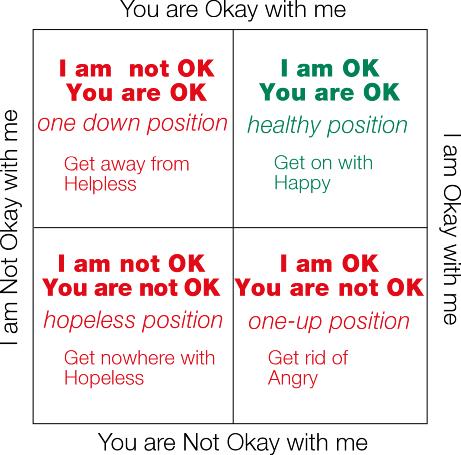
Many people who grew up in dysfunctional families find themselves in relationships with codependents and counter dependents. Codependents are people who come from the mindset of “I am not okay, you ARE okay.” Counter dependents come from the position, “I AM okay, you are NOT okay.”

This is based on transactional analysis. Below are the different approaches:

Eric-berne3

Developing an emotional backbone requires a healthier approach, ie the “I am okay, you are okay” perspective. However, this is not likely with a person who is codependents or counter dependent.

I believe a strong, developed emotional backbone is crucial to having and maintaining healthy relationships. If you do not have an I am okay, you are okay approach you are going to perpetuate dysfunctional patterns in your relationships.

Most of us desire an emotional backbone–a strong sense of self, an ability to be less reactive, less shaken by conflicts, to be able to express our wants/need clearly, to stand firm with boundaries, to say no in a healthy way without guilty, want to reduce dysfunctional relationship patterns, to not undermine ourself, and to discover who we truly are.

To have a strong emotional background is to become WHO you truly are–not who others want or need you to need you to be. Only when you get to this point can you give and receive REAL love.

When we try to change ourselves from the outside in, we often feel defeated when we find ourselves back in our old ruts. We find we cannot keep the change going.

It can hard to catalyze change in our life and relationships if we are not self-differentiated. A person who is NOT differentiated will struggle with change.

For instance perhaps you are a person who knows YOU NEED to start to SPEAK up for yourself. Well-meaning family and friends often tell you to start speaking up for yourself.  But for you, it has always been a struggle for you to speak your piece. The difficulty is there is likely an entrenched pattern that exists in your relationships, with relationship imbalances, thus it can be risky for you to start to assert yourself. IF you speak up, that can cause problems and difficulties, especially if you are not prepared for how to handle other people’s reactivity.

If you do not know what your next step is, if you cannot predict possible outcomes, often that one little tip “you need to speak up” is not helpful. You need to be OKAY with ANY possible outcome as controlling other people’s reactions is not realistic. Knowing we cannot control other people is just a given for a self-differentiated individual, but for a person who has not achieved this level of self-differentiation, they work hard to control other people’s reactions and the outcomes of situations.

For example, a wife goes home to her husband and says she needs some time for herself. She is always taking care of the house, the kids, working. She read she needs to “speak up for herself.” Her friends and family have been encouraging her to start “speaking up.” Her husband, on the surface, allows her the time and agrees she deserves it. The wife decides to plan a ladies night out for the first time in YEARS. But then her husband ends up calling/texting her numerous times that night when she is having said time for herself out of his own anxiety, ruining her alone time, and the wife says it just isn’t worth it and ends up giving up on getting her needs met. No more ladies nights out for her!

Standing up for yourself is not going to be effective if you have not ALREADY done the emotional legwork on developing an emotional backbone. There is A LOT more to developing an authentic emotional backbone and a lot more going on than just “speaking up for yourself.”

To build an emotional backbone, you need to be able deal with the fight between us AND us–not between us and others. Not everyone will agree with your priorities but when you have an emotional backbone you know that is their prerogative. It is not going to impact how your choose to conduct your life. You live your life according to your values and beliefs, not needing and requiring the validation of others. You know anyone worth having in your life will respect you and your values.

This is true self-differentiation. This is having an emotional backbone.

Power and growth needs to happen within me before I can expect others to take me seriously, to respect me, to hear me, things need to happen within me. Often we do not do this self work, we just expect it to happen with OTHER people and then wonder why it doesn’t.

You need to take yourself seriously before you can expect others to take you seriously. 

Healing and recovering from your own demons will begin to stop the fight between you and you.

Others often take advantage of the internal fight we experience. The reason people who are self-differentiated can remain firm and set boundaries is because they do not feel too much guilt, shame, or fear abandonment because they already HEALED those parts of themself and their childhood wounds.

Feeling guilt, shame, and fear of abandonment are all signs of an undifferentiated individual.

Too much fear of rejection means you have work to do on yourself. The need for approval from others means you have a long way to go on your journey to self-differentiation.

How can you develop and strengthen YOUR emotional backbone?

One, we have to deal with the internal before we deal with the external. We have to do the work on ourself before we can begin to develop better relationships with other people in our life. Only when we have a healthy relationship with ourself can we have healthy relationships with others.

Second, it is important to recognize that to have an emotional backbone does not occur because we learned a few simple behavioral changes or assertiveness changes. To have long-lasting success, deeper issues and systemic stuckness needs to be addressed, which is why counseling can be such a real benefit.

Through counseling, you can learn to calm yourself in highly charged emotional relationship situations. If we cannot calm ourselves, we will fall back into the ruts of the past and our emotional demons will take ourself. Emotional regulation is a must to developing an emotional backbone.

Thirdly become an expert on YOU. I don’t mean become selfish. I mean become an expert on YOUR thoughts and emotions, NOT an expert on the thoughts and emotions of OTHERS. If you are caught up in trying to figure out what other people are thinking and feeling, you are in a state of enmeshment. It is NOT your job to figure out the emotional map of others.

Oftentimes, we are far too much an expert on others and NOT an expert on ourselves.

Fourth, we need to let go of our naive and immature illusions, which allows us to grow up emotionally (although many people don’t want to do this because it is hard to grow up emotionally). Our illusions keep us WEAK and SOFTEN our emotional backbone. Being emotionally grown up means managing our feelings, not trying to manage the feelings of others.

Having an emotional backbone means being willing and able to let go of getting our needs met by other people. To let go of our illusions that others can make us happy and fulfilled.

These illusions might be: I NEED my father to love me, I NEED my mother to be proud of me, I NEED everyone to get along to be happy and whole, I NEED my husband to think I am special to be happy, I NEED my kids to not hurt my feelings so I can feel good about myself, I NEED others to stop betraying me to be happy, I NEED others to follow my advice to feel happy, I NEED my wife to love me so I can be happy…..

Do any of these sound familiar? These are some of the illusions we have that keep up from having a good and healthy emotional backbone.

Emotional grown-ups own their own stuff and leave other people to take ownership of THEIR stuff. We feel empathy but know we cannot do the self-development work for others.

Fifthly, deal with any codependency issues, emotional fusion, enmeshment, all of which will be required to develop an emotional backbone.

People with an emotional backbone are able to love and care for themselves. They are flexible and do not need to be propped up by others.

Sixth, doing self-care can help develop an emotional backbone.

Self-care is an important part of our well-being.

b1

Being a self-differentiated individual with an emotional backbone is the foundation of having healthy relationships with one self and others.

The truth is when you have a strong emotional backbone, you are not trying to control others. Simultaneously, you are also NOT allowing others to control you. Before you can be with someone with an emotional backbone, you need to develop your own.

Most people are unaware if they are indeed conducting their lives with a lack of self-differentiation. They are not even conscious of how fused their feelings are with other people’s.

People may mature physically, have careers, get married, have children yet STILL be an emotional child. This is what much of Murray Bowen’s research and literature posits.

Lacking an emotional backbone is often due to unresolved childhood issues, the defenses one develops in childhood, and ongoing emotional pain.

I truly believe developing an emotional backbone is the cornerstone to a happy and focused life. It is crucial for having healthy relationships with family, friends, and romantic partners.

People with an emotional backbone are rational, follow through on goals, have equality in their relationships, have final say on their decisions, respect other people’s decisions, and KNOW what they think and feeling outside of the noise and chatter from others.

If you feel you are struggling with developing an emotional backbone, counseling can be a great place to start the process.

To schedule a counseling session with me:

Erin Doyle Theodorou, M.Ed, LPC, NCC

theodorou therapy LLC

590 Franklin Ave. Suite 2, Nutley, NJ 07110

973-963-7485

etheodorou@theodoroutherapy.com

growing_up_2

Why We Love Putting People in a Box and Why We Should Reevaluate Our Views on Ourselves, Others, and Life In General

On this journey through life, we are different people at various points in our journey. Surely you are not the same person at 48 that you were at 18.

a3

Yet the people in our lives often view us as who we were when they met us. More often than not it will be a struggle for them to shift their perception of you. Once they view you a certain way, regardless of the changes and progress you make in your life, it may be a challenge for them to take you out of the “box” they put you in.

This is why if you ask five people to describe someone, you will likely get five extremely varied answers. We meet people at different points in time impacting our perception of the individual.

Even our own self-concept may be reflective of a point in time that no long holds true today. Ask yourself when is the last time you took stock of who you are TODAY not who you were years ago? Do you still view yourself as an extrovert because growing up you liked to go out and socialize but now you spend your weekends at home on the couch dreading the mere thought of going to a party? Do you consider yourself a career driven person but have not been in the workforce in five, ten, fifteen years? Do you view yourself as athletic but have not been in shape since your college years? Often we do not update our self-concept as we evolve through life.

There is no right or wrong here. But at different stages of our life, to an extent, our identity shifts. You are a different “you” as a child vs. college student vs. a young professional vs. a person balancing career and family vs. someone who is retired. Yet oftentimes we hold onto an identity that is no longer valid which can in turn create conflict within ourselves and with the outside world.

Our self-concepts are not always perfectly aligned with reality. Our perceptions of others are not either. While we all tend to distort reality to a certain degree, congruence occurs when self-concept is fairly well aligned with reality. 

Try to reflect on the following three questions:

  • Do you think your view of yourself is how other people view you?
  • Can you think of someone you and a friend view completely differently?
  • Do you believe most people are aware of how others perceive them?

Too many people live on auto pilot. Many of us do not reflect on our beliefs of ourselves, others, and life in general to see if they are still relevant or hold true to this day.

People use labeling as a tool to resolve the complexity of their environments. It is easier to put people in categories than take the time to analyze the complexities of the individual (complexities which we all have). It is simpler and easier to label and categorize. The same can hold true for the views we hold of ourselves.

Not only do we tend to stereotype people, but once we label someone, we fight like hell to keep them in that category. Even if the face of evidence to the contrary. This helps to mitigate our cognitive dissonance.  (Cognitive dissonance refers to a situation involving conflicting attitudes, beliefs or behaviors. This produces a feeling of mental discomfort leading to an alteration in one of the attitudes, beliefs or behaviors to reduce the discomfort and restore balance).

Ironically enough as clinicians we HAVE to use diagnostic labels to interpret clients’ behavior to bill insurance companies. I am not a big fan of such protocol but it is a requirement for insurance companies to cover services. I feel people are so much more than the categories we put them in.

Yet in private practice we are able to change the diagnostic label as a client progresses through treatment. In day-to-day life, it seems our labels tend to be more rigid and fixed.

We label people: talkative, outgoing, shy, kind, rude, evil, sweet, smart, dumb, hardworking, successful, not successful, rich, poor, the list goes on and on.

More often than not I find people do not like to change their long-held views or labels. Of themselves OR others. Once they made up their mind on WHO someone is–it is what it is.

Even if they experience discomfort in the face of evidence which is contrary to their preconceived views, they will work hard to twist the truth and to justify their faulty perceptions. To reduce the discomfort, they will often use a myriad of defense mechanism (ex. denial, projection, rationalization) to mitigate any cognitive dissonance between themselves and the target of their label/judgement.

We also do the same with the view we hold of ourselves. And of life in general (we see this play out all the time in political discussions).

Not everyone, but many people seem to struggle with changing how they view a person (or oneself) once their mind has formed an opinion.

It is like our mind is a file cabinet. When we see someone we unconsciously pull the file on that person. The problem is we may have not updated our files in 5, 10, 15, 20 years or more.

For instance, one woman I know has repeatedly pointed out to me a mistake a person had made in college. The thing is the woman in question is well into her FORTIES. Thus this person is judging someone based on a mistake made over 20 years ago.  The person was using this mistake, from twenty years ago, as a reflection on this person’s present day character. In reality, this woman was a totally different person in the here and now. This type of type casting is reflective on this rigid, inflexible categorizing, people have a tendency to indulge in. Perhaps you have your own examples coming to mind.

The thing you may notice is that people like to stereotype you. They are going to do all in their power to put you in a box based on how you look, where you work, and where you live particularly at the point in time they met you. This allows them to mentally file you away alongside the thousands of other boxes consuming their mental files.

I have seen this commonly occur in families. It’s all an inside job. The only way we’re able to look at the world is through our own unique lens.

The truth is, all of us are capable real and meaningful change, but we often criticize those who display it. For some, having people “figured out” is preferable to actually figuring them out.

People do not want to take the time to reevaluate a person or their relationship to said person based on the here and now. What compels us to define ourselves and others by often narrow parameters, putting us into categories? People are busy and people are lazy. It is convenient. Labels enable people to make what they believe to be useful generalization. We then use these labels to justify our own behavior in turn.

This can in turn make us feel we know what is best for other people. This is a side effect of our short-sighted judgments. This has been done to me and I know I have done this from time to time with others.  It’s one thing if someone’s actions and behavior are directed at us personally, but when those decisions aren’t,  intervening, will bring about anger and frustration. We use our labels and generalizations to rationalize our actions towards others.

Labels have a way of dehumanizing people. It is okay to have different values. Life is a lot more complex than many of us are willing to acknowledge. 

Yet when we think we know what’s best for someone’s else life, what we are essentially doing is failing to recognize we are all unique people with different values. Keeping people in a box helps us to feel in control. Thus instead of accepting someone as they are NOW, we fight to view them as something we are comfortable with. When we view a person as who they were ten, fifteen, twenty years ago, it can be hard to connect with them if we are not able to communicate with who they are in the here and now.

Do you see the issues that can arise with this type of thinking? Of stereotyping someone and imposing your opinion of what’s best? This type of thinking and behavior plays out often in our society including our political landscape.

Perhaps you have been there before. Someone hurts you and you decide they did it because they’re an evil or bad person. You disregard all evidence to the contrary. When someone else speaks kindly of them, you assume that person does not know the “real” them like you do. Or someone says something that threatens a belief you hold dear, so you decide they’re wrong. Maybe you view yourself a certain way and when someone says something that contradicts this view, you attack them.

We fight fiercely to hold onto our beliefs. We push hard to get people to act in a way we deem best. At the core, this is about feeling secure and comfortable.

Yet being emotionally and mentally healthy means not labeling other people and putting them in boxes that we file away. It means giving ourselves and others the freedom to change.

We are not meant to be put in boxes. As people, we are always growing, changing, and evolving (hopefully that is).

In a way if you are not growing, you are dying.

When we look around at other people, we tend to be naturally drawn to people like us. Conversely, we may be repelled by certain types of people who seem very unlike us. This is why change can feel so threatening. Again, we see this play out in the political realm. But for our own peace of mind we need to begin to see most people do not fit neatly into categories. Life is messy. Things change. People are constantly in flux. The world is constantly moving forward–whether we are on board or not.

As it relates to ourselves, progress is important to be being happy. As humans if we are not growing more often than not we are not going to feel fulfilled. Think of people who have not changed any aspect of their life in five, ten, fifteen, twenty years (maybe you are thinking of yourself). These people in all likelihood lack a vibrancy to them. The thing is growth has a sense of aliveness to it. What makes us feel alive is progress.

The time has come for us to start thinking OUTSIDE the box instead of forcing others (and ourselves) into a box. The time has come to begin making progress in our own lives and allowing others to evolve. Let us not continue to box ourselves or others in.

a1

To schedule a counseling session with me (AND if you are a reader who lives in New Jersey):

https://anewcounselingservices.com/erin-theodorou%2Cm-ed-%2C-lpc

Erin Doyle Theodorou, M.Ed, LPC, NCC

Anew Counseling Services LLC

617 Oradell Avenue, Suite 3, Oradell, New Jersey, 07649

(551) 795-3822
etheodorou@anewcounselingservices.com