Are You a Good Person? The Litmus Test

Do you think you are a good person?

The mere fact you are choosing to read this means you’re wondering if in fact you are.

I find most people view themselves as “good.” Not perfect, but good. Most of us would be hard-pressed to find someone who does not regard themselves as a “good person.”

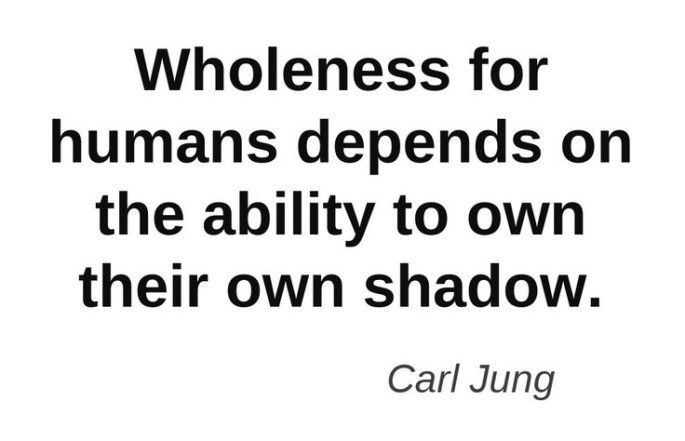
Yet how many people do you know that acknowledge the darker parts of their personality? Or their shadow self as Jung called it.

In short, the shadow is the “dark side”. Many people do NOT recognize the darker components of their personality.

Because most people tend to reject or remain ignorant of the least desirable aspects of their personality, the shadow is largely negative. 
b2.jpg

The problem with viewing yourself as wholly good, without acknowledging your shadow self, is it can lead to unhealthy ways of coping.

As humans it is important to feel we behave and act in a manner that reflects our self-image. How can you stay congruent with your identity, if you view yourself as a good person, in absolute terms, when you inevitably do wrong? This leads to justifying bad behavior. It leads to distorting the truth and repressing emotions we do not have the courage to face.

When people view themselves as wholly good behave badly, they find ways to justify their behavior to themselves (and others) as to maintain their self-image of being “good” and keep cognitive dissonance at bay.

The truth is none of us are good people 24 hours a day, seven days a week.

We all are fallible, we all have moments of weakness, we all act out of character (this is distinct from people we may encounter with poor character who act this way over and over again over the course of our relationship with them). No one who walks among us does not behave badly from time to time. It is part of the human condition and part of why conflict is so common in our relationships.

Being a good person is a value many of us in all likelihood hold dear (narcissists and sociopaths excluded).

Yet how do we know for sure if we are in fact a good person? “Good” is a very relative term. There is no universal truth that defines what being a “good person” is and looks like.

Some people think they’re “good” because they don’t intentionally go out and harm others, and others believe they are good because they do superficial acts of kindness for others.

Yet if you believe yourself to be a “good person” program, consider the following questions:

Are you a good person if you hurt people but your intention was not to do so?
Are you a good person if someone tells you that you are causing them pain but you disregard how they feel?
Are you a good person if you constantly speak ill of others?
Are you a good person if you lie on your taxes? Lie to your spouse? Lie to your children?

Do you ever feel envy or jealousy towards other people? Do you feel resentment towards the people in your life?

Are you honest with yourself?

Are you a good person if you steal from the government? On whatever level you may be playing the game…
Are you good person if you cheat–on a test, partner, or someone else? If you cheat your company?

When you witness poor behavior in others (lying, judgement, dishonesty, self-deception), can you acknowledge those same impulses inside yourself?

Are you a good person if you wish bad on others?

Do you express rage and contempt towards others?

Do you consider yourself a good person without accepting the darker parts of your personality?
Are you a good person if you are unaware of the negative emotions that arise within you through the day?

Do you believe it is wrong to feel hatred towards the people you love?

In terms of behavior:

~Would you give up your seat for a disabled person or pregnant woman on the train?
~Would you stick up for someone being verbally berated?

~How often do you help someone with extra bags?
~Do you donate your time or money to causes outside of yourself?

~Do you hold the doors open for others?

~Do you offer words of encouragement and kindness freely to others?

All the questions give insight into your character.

Are you happy with how your answer these questions? Do you find you can make excuses for yourself to justify your OWN bad behavior/character flaws but have the habit of condemning others?

I don’t believe that any human being is bad through and through or good through and through. We all have some of each inside us.  I do feel people’s character exists on a continuum–with character disturbed on one end and being virtuous on the other end.

The truth is some people have more good in them than bad.

The truth is some people have more bad in them than good.

It is important to know which person you are dealing with at any given time.

Maybe you’ve experienced this before: Dealing with someone who thinks he’s much nice or kinder than he really is. It can be hard to manage and maintain a relationship with someone who is not as good as he or she believes himself to be.

It can also be hard for people to maintain relationships with us if we are not a good of a person as we believe ourselves to be.

You need to be aware of the good AND bad in you. And others.

Viewing oneself as “good” explains a wide range of common defense mechanisms– denial, minimizing/justifying one’s own “bad”behavior, lying, becoming defensive.

The fact is our character is NOT set in stone—we are all capable of growing into a better person IF we are able to adopt a realistic self-image. We need to be able to look deeply into our shadow self if we want to move beyond the darker aspects of our personality.

We can see everyone feels justified in their own shoes. Every action that a person takes take, good or bad, they can always tell themselves it is justified  – otherwise they would not be able to perform the act in question at all.

We all want to be our best, but many people wonder if it’s actually possible for people to become better–themself included. The answer is a resounding yes. There are always ways to improve yourself.

Some general suggestions for a path forward:
1)Support others. Contribute to things outside of yourself–the larger community. Offer kind words and encouragement to the people you encounter. Consider how your words, actions, and behaviors impact others. Do not enable the bad behavior of others at the expense of someone else. Do good and good will come back. We all eventually reap what we sow.

2)Let go of anger. Think before you speak. Words said in anger can only be forgiven, not forgotten. A mindfulness practice can help you to lower your baseline feelings of anger. Much of anger arises from ruminating over the past–past injustice, grievances, pain from long ago. Stress can up our ability to lash out in anger. Consider adopting stress management techniques to your daily routine.

3)Take care of yourself–mentally, emotionally, physically. Exercise, eating well, meditation, seeking out counseling…all lead to building a strong foundation for living a good life and empowering yourself to be a better person.

4)Learn to set boundariesfor others AND yourself. We talk often about setting boundaries with other people but you should have your own set of standards in how you will or will not conduct yourself. Example–you won’t scream at other people, curse people out, threaten people, smear people’s names to others, steal, cheat, etc.

5)Reflect on the following questions (Forbes):

~What, or who, is worth suffering for?

~What can my most aggressive judgments of others tell me about myself?

~Are my opinions of others fixed, or do they evolve? Is that fair?

~Does my daily routine reflect my long-term goals?

~What do the things I envy tell me about what I want to give myself?

~If I could meet the best possible version of myself in an alternate reality, what would that person be like?

If you feel like you are struggling to become a better version of yourself, counseling can be a way to figure out a plan for your life, moving forward.

bad 1.jpg

To schedule a counseling session with me (AND if you are a reader who lives in New Jersey):

https://anewcounselingservices.com/erin-theodorou%2Cm-ed-%2C-lpc

Erin Doyle Theodorou, M.Ed, LPC, NCC

Anew Counseling Services LLC

617 Oradell Avenue, Suite 3, Oradell, New Jersey, 07649

(551) 795-3822

etheodorou@anewcounselingservices.com


Building an Emotional Backbone: A Family System Approach

Do you often feel taken advantage of by others? Is it a struggle for you to speak up for yourself? Do you find yourself saying yes when you want to say no? Do you feel the need to have other people’s approval?

Are you uncomfortable with asserting yourself? Do you get angry at how other people live their lives?

Do you find you allow yourself to be controlled by other people? Do you find yourself trying to control others? If you do, it is time to build up your emotional backbone.

I think there are many misconceptions about what an “emotional backbone” is.

Having an emotional backbone is pivotal to self-differentiation, a Bowen Family System concept. Self-differentiation is the ability to separate feelings from thoughts.

People who are poorly self-differentiated have difficulty separating their own feelings from other people’s feelings; they often look to other people to define how they think about issues, feel about people, and interpret their experiences.

A person who is self-differentiated has an emotional backbone–they do not look to their family, friends, or partner to define them. This means being able to have different values and opinions from other people in your life but be able to stay emotionally connected to them.

It is being able to lovingly detach from people who are not emotionally healthy and will inevitably impede on your growth and development. You cannot truly become self-differentiated and simultaneously participate in perpetuating dysfunctional relationship patterns.

54233800_621684751609790_5145180055340580864_o

Developing an emotional background when raised in a dysfunctional family system is often difficult for the individual. This is where counseling can be very beneficial to becoming someone with a strong emotional backbone.

An emotional backbone is a sign of strength of character. It is an unwillingness to be used, to be taken for granted, to be mistreated, to be abused, and a firm commitment to uphold one’s beliefs and values.

Do you have a strong emotional backbone? Ask yourself the following:

1)Do you resent others?

2)Do you often complain to no avail? Do your complaints fall on deaf ears?

3)Do you avoid conflict?

4)Do you say yes when you want to say no?

5)Do you feel taken advantage of?

6)Do you feel unappreciated?

7)Do you allow your anger to build and come out in unhealthy ways?

8)Do you compromise your self-care?

9)Do you people please?

10)Do you seek the approval of others?

11)Do you allow others to mistreat you?

These are a job signs you may be struggling with developing a strong emotional backbone.

Oftentimes, I believe people confuse being louder, being stronger, saying things more angrily, speaking up without knowing how the relationship is going to be effected by your words, or speaking from the unhealthy part of oneself is having an emotional backbone. This is not what having an emotional backbone is.

Yet this is common in a dysfunctional family system which plays out in ALL our relationships not just with members of our family of origin.

This type of dysfunction often serves the status quo instead of being a catalyst for healthy change in our lives, causing the same unhealthy cycles to play out over and over again over the course of one’s life.

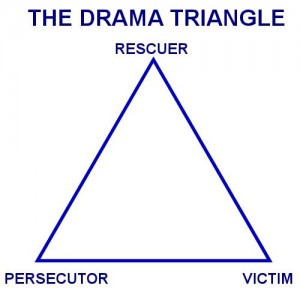
Switching between persecutor and victim is common in a dysfunctional relationship.  It goes round and round–certainly not my idea of having an emotional backbone. This is just people switching chairs at the same concert.

Persecutors criticize and blame the victim, can be very controlling, rigid, angry, and unpleasant.  The victim see themselves as powerless, helpless,  hopeless, and can want kid glove treatment from others.

A person with a developed emotional backbone sees themselves as able to determine the conditions of their life including what relationship patterns they will be an active participant in.

DRAMTRIANGLE-1-300x300

Counterdepedents are controllers. Very much the persecutors.

Codependents are people pleasers. Very much the victims.

Neither have healthy, strong emotional backbones.

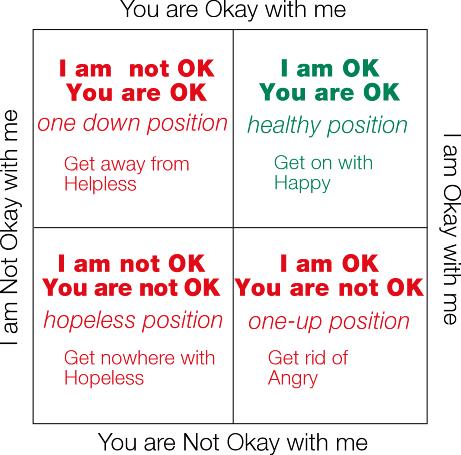
Many people who grew up in dysfunctional families find themselves in relationships with codependents and counter dependents. Codependents are people who come from the mindset of “I am not okay, you ARE okay.” Counter dependents come from the position, “I AM okay, you are NOT okay.”

This is based on transactional analysis. Below are the different approaches:

Eric-berne3

Developing an emotional backbone requires a healthier approach, ie the “I am okay, you are okay” perspective. However, this is not likely with a person who is codependents or counter dependent.

I believe a strong, developed emotional backbone is crucial to having and maintaining healthy relationships. If you do not have an I am okay, you are okay approach you are going to perpetuate dysfunctional patterns in your relationships.

Most of us desire an emotional backbone–a strong sense of self, an ability to be less reactive, less shaken by conflicts, to be able to express our wants/need clearly, to stand firm with boundaries, to say no in a healthy way without guilty, want to reduce dysfunctional relationship patterns, to not undermine ourself, and to discover who we truly are.

To have a strong emotional background is to become WHO you truly are–not who others want or need you to need you to be. Only when you get to this point can you give and receive REAL love.

When we try to change ourselves from the outside in, we often feel defeated when we find ourselves back in our old ruts. We find we cannot keep the change going.

It can hard to catalyze change in our life and relationships if we are not self-differentiated. A person who is NOT differentiated will struggle with change.

For instance perhaps you are a person who knows YOU NEED to start to SPEAK up for yourself. Well-meaning family and friends often tell you to start speaking up for yourself.  But for you, it has always been a struggle for you to speak your piece. The difficulty is there is likely an entrenched pattern that exists in your relationships, with relationship imbalances, thus it can be risky for you to start to assert yourself. IF you speak up, that can cause problems and difficulties, especially if you are not prepared for how to handle other people’s reactivity.

If you do not know what your next step is, if you cannot predict possible outcomes, often that one little tip “you need to speak up” is not helpful. You need to be OKAY with ANY possible outcome as controlling other people’s reactions is not realistic. Knowing we cannot control other people is just a given for a self-differentiated individual, but for a person who has not achieved this level of self-differentiation, they work hard to control other people’s reactions and the outcomes of situations.

For example, a wife goes home to her husband and says she needs some time for herself. She is always taking care of the house, the kids, working. She read she needs to “speak up for herself.” Her friends and family have been encouraging her to start “speaking up.” Her husband, on the surface, allows her the time and agrees she deserves it. The wife decides to plan a ladies night out for the first time in YEARS. But then her husband ends up calling/texting her numerous times that night when she is having said time for herself out of his own anxiety, ruining her alone time, and the wife says it just isn’t worth it and ends up giving up on getting her needs met. No more ladies nights out for her!

Standing up for yourself is not going to be effective if you have not ALREADY done the emotional legwork on developing an emotional backbone. There is A LOT more to developing an authentic emotional backbone and a lot more going on than just “speaking up for yourself.”

To build an emotional backbone, you need to be able deal with the fight between us AND us–not between us and others. Not everyone will agree with your priorities but when you have an emotional backbone you know that is their prerogative. It is not going to impact how your choose to conduct your life. You live your life according to your values and beliefs, not needing and requiring the validation of others. You know anyone worth having in your life will respect you and your values.

This is true self-differentiation. This is having an emotional backbone.

Power and growth needs to happen within me before I can expect others to take me seriously, to respect me, to hear me, things need to happen within me. Often we do not do this self work, we just expect it to happen with OTHER people and then wonder why it doesn’t.

You need to take yourself seriously before you can expect others to take you seriously. 

Healing and recovering from your own demons will begin to stop the fight between you and you.

Others often take advantage of the internal fight we experience. The reason people who are self-differentiated can remain firm and set boundaries is because they do not feel too much guilt, shame, or fear abandonment because they already HEALED those parts of themself and their childhood wounds.

Feeling guilt, shame, and fear of abandonment are all signs of an undifferentiated individual.

Too much fear of rejection means you have work to do on yourself. The need for approval from others means you have a long way to go on your journey to self-differentiation.

How can you develop and strengthen YOUR emotional backbone?

One, we have to deal with the internal before we deal with the external. We have to do the work on ourself before we can begin to develop better relationships with other people in our life. Only when we have a healthy relationship with ourself can we have healthy relationships with others.

Second, it is important to recognize that to have an emotional backbone does not occur because we learned a few simple behavioral changes or assertiveness changes. To have long-lasting success, deeper issues and systemic stuckness needs to be addressed, which is why counseling can be such a real benefit.

Through counseling, you can learn to calm yourself in highly charged emotional relationship situations. If we cannot calm ourselves, we will fall back into the ruts of the past and our emotional demons will take ourself. Emotional regulation is a must to developing an emotional backbone.

Thirdly become an expert on YOU. I don’t mean become selfish. I mean become an expert on YOUR thoughts and emotions, NOT an expert on the thoughts and emotions of OTHERS. If you are caught up in trying to figure out what other people are thinking and feeling, you are in a state of enmeshment. It is NOT your job to figure out the emotional map of others.

Oftentimes, we are far too much an expert on others and NOT an expert on ourselves.

Fourth, we need to let go of our naive and immature illusions, which allows us to grow up emotionally (although many people don’t want to do this because it is hard to grow up emotionally). Our illusions keep us WEAK and SOFTEN our emotional backbone. Being emotionally grown up means managing our feelings, not trying to manage the feelings of others.

Having an emotional backbone means being willing and able to let go of getting our needs met by other people. To let go of our illusions that others can make us happy and fulfilled.

These illusions might be: I NEED my father to love me, I NEED my mother to be proud of me, I NEED everyone to get along to be happy and whole, I NEED my husband to think I am special to be happy, I NEED my kids to not hurt my feelings so I can feel good about myself, I NEED others to stop betraying me to be happy, I NEED others to follow my advice to feel happy, I NEED my wife to love me so I can be happy…..

Do any of these sound familiar? These are some of the illusions we have that keep up from having a good and healthy emotional backbone.

Emotional grown-ups own their own stuff and leave other people to take ownership of THEIR stuff. We feel empathy but know we cannot do the self-development work for others.

Fifthly, deal with any codependency issues, emotional fusion, enmeshment, all of which will be required to develop an emotional backbone.

People with an emotional backbone are able to love and care for themselves. They are flexible and do not need to be propped up by others.

Sixth, doing self-care can help develop an emotional backbone.

Self-care is an important part of our well-being.

b1

Being a self-differentiated individual with an emotional backbone is the foundation of having healthy relationships with one self and others.

The truth is when you have a strong emotional backbone, you are not trying to control others. Simultaneously, you are also NOT allowing others to control you. Before you can be with someone with an emotional backbone, you need to develop your own.

Most people are unaware if they are indeed conducting their lives with a lack of self-differentiation. They are not even conscious of how fused their feelings are with other people’s.

People may mature physically, have careers, get married, have children yet STILL be an emotional child. This is what much of Murray Bowen’s research and literature posits.

Lacking an emotional backbone is often due to unresolved childhood issues, the defenses one develops in childhood, and ongoing emotional pain.

I truly believe developing an emotional backbone is the cornerstone to a happy and focused life. It is crucial for having healthy relationships with family, friends, and romantic partners.

People with an emotional backbone are rational, follow through on goals, have equality in their relationships, have final say on their decisions, respect other people’s decisions, and KNOW what they think and feeling outside of the noise and chatter from others.

If you feel you are struggling with developing an emotional backbone, counseling can be a great place to start the process.

To schedule a counseling session with me:

Erin Doyle Theodorou, M.Ed, LPC, NCC

theodorou therapy LLC

590 Franklin Ave. Suite 2, Nutley, NJ 07110

973-963-7485

etheodorou@theodoroutherapy.com

growing_up_2

Why We Should Not Take on Other People’s Problems: A Counselor’s Perspective

a1.jpg

Have you ever found yourself growing frustrated because “that person just won’t listen to my advice,” or because “don’t they seem to recognize how they are hurting themselves by acting like that,” or because “I can’t believe someone could be so irresponsible.”

I know I am guilty of this from time to time.

These are coming refrains we say to ourselves when we are in the midst of taking on other people’s problems. Maybe we feel compelled to solve the problem for our loved ones.  We can’t stand to watch them make a mess of themselves or their lives.

Yet we have no choice BUT to let other people live their lives. However they see fit. Without us making choices for them.  Or telling them what we THINK is the right choice. The bottom line is we cannot make ANYONE do anything they do not want to do.

We all, at least on an intellectual level, know that we do not have control over ANYONE but ourselves. Yet on an emotional level it can be hard to accept. One of those truisms of life I think we all struggle with from time to time.

As friends, family members, romantic partners…we can support, listen, encourage, ASK if someone wants our advice or help (but with the acceptance they may in fact NOT want our advice or help). It is then our job to respect the response we get regardless of it is the one we hoped for.

When we offer unsolicited advice, we alienate and annoy those around us. We also in turn frustrate ourselves when said advice is not taken.

The world is a tough place and you are not doing anyone any favors by solving their problems for them.  We can’t live other people’s lives FOR them. This can be especially hard to accept as a parent.

b1.jpg

How do you KNOW if you might be taking on someone else’s problems?

-You think about them AND their problems all the time.

-You talk about the problem. ALOT.

-You surrounded yourself with needy people.

-You feel you listen to everybody but NOBODY listens to you.

-You feel a strong sense of obligation to help others even when they don’t ask.

-You ignore your own problems because it is less painful to focus on OTHER people’s problems.

-You feel unhappy even though on paper nothing is wrong with your life.

-You feel the need to be validated by others.

-You find yourself experiencing a simmering resentment.

-You have been referred to as a peacemaker, helper, or fixer.

These are just a few signs you may be struggling with taking on other people’s problem.

How to be supportive without taking on another person’s problem is a fine line to walk.

Sometimes our desire to help, fix, or be the hero clouds our judgment.

Even when we KNOW what someone we care about is doing is unhealthy, self-destructive, bad, wrong, insert value judgement here, the challenge for us is respecting when they are not opening to hearing it or doing anything about it. If we cannot offer that respect, all we do is cause misery. For them AND ourselves.

People are free to mess up their own lives without us swooping in to save them. Trying to solve other people’s problems usually makes it worse, not better. Often we inadvertently create a whole other host of problems in the process.

Problems can only be solved firsthand.

You may be thinking, “isn’t it your job as a counselor to help people with their problems?” and the answer is yes, of course. To help them. Not to do it for them. The reality is if someone doesn’t want to do anything about the issue, there is nothing anyone can do to change them. Unless they want to change. As soon as you or I or any of us think it’s our responsibility to “fix” another person, we are in trouble.

My role as a counselor is to facilitate the process–but it is a client’s journey, just as anyone’s journey, is their own.

Does it ever drive me crazy? Absolutely.

Ultimately, I believe everyone has a right to lead their own life as they see fit.  We all have a right to our own choices, beliefs, behaviors. We are also responsible for the CONSEQUENCES for those choices, beliefs, behaviors.

As a counselor if someone is not ready to heal, grow, and face the truth of their life, I believe in respecting their autonomy (which is one the key ethical principles counselors follow).

If you have felt completely frustrated and hopeless about trying to solve a problem, it may not be a problem for you to solve.  It may be you are trying to solve another person’s problem. Or it might not be a problem at all but a truth that needs to be accepted.

If you find you have been trying to change or fix people and their problems for years,  how do you get off this roller coaster ride? Counseling can be a great avenue for you to sort through what drives this need. It can be difficult to stop the compulsive desire to fix other people.  Trying to solve other people’s problems takes its toll on a person.

Practice taking a step back.

Remind yourself you have your own beautiful life journey to attend to.

a11.jpg

To schedule a counseling session with me (AND if you are a reader who lives in New Jersey):

https://anewcounselingservices.com/erin-theodorou%2Cm-ed-%2C-lpc

Erin Doyle Theodorou, M.Ed, LPC, NCC

Anew Counseling Services LLC

617 Oradell Avenue, Suite 3, Oradell, New Jersey, 07649

(551) 795-3822

etheodorou@anewcounselingservices.com
Not Everyone Wants to Be Happy

One of the most common goals people express is their desire to be happy.

As Americans, our Declaration of Independence speaks to our  right to the “pursuit of happiness” ie our RIGHT to chase whatever our subjective happiness may be. We have a right to PURSUE happiness but obtaining it is not a given.

As a culture, we spend boatloads of money trying to figure out what EXACTLY personal happiness means to us. For Americans, happiness is almost an OBSESSION. The desire for it is woven into the fabric of our culture but in other parts of the world happiness is held in less esteem.

Often people turn to counseling with the objective “to be happier” at the end of the treatment process. Many of us search for happiness like the holy grail.

But happiness as a goal is not desired by all. The truth is not everyone wants to be happy.

Now many people would deny that being the case. I find most people readily admit to others they WANT to be happy. But their thoughts and actions denote otherwise.

People often destroy their own happiness.  THEY themselves destroy it. It can be painful to watch someone behave in such a self-destructive manner.

It plays out in a familiar fashion.

People hold onto relationships (romantic, familial, friendships) that make them feel bad. People continue in jobs that make them miserable. People give their power away to others–allowing other people to make them feel less than or ruin their days. People treat others poorly then wonder why they are lonely. People hold onto bad habits at the expense of their mental and physical well-being.

People negatively judge others. People negatively judge themselves. They think they need to be perfect to be loved. They seek the approval of others but do not give such approval to themselves.

People commonly obsess about the past. People often worry about the future. People frequently ruminate over things they can’t change–namely anything in the external world outside of themself.

People let their ego grow out of control. People procrastinate their ambition. People keep toxic people in their life. People continue being their own worst critic. People push people they love away.  People give up before they even start.

The truth is many people at a certain point in life settle. People settle for a life that does not bring them the happiness they desire. The moment a person chooses to settle is the moment them begin a slow death on the inside.

th

As a counselor, if a client tells me that want to be happy, my automatic response is, WHAT does happiness mean for you? Because the truth is happiness can look quite different depending on who you ask. Happiness is not one universal outcome.

So why isn’t someone happy with their life?  The answer is often simple. Many people are not happy because they don’t really want to be. 

55ae37d226334ae1449925db29128f48--random-thoughts-positive-thoughts

I am not talking about people who have extenuating tough life circumstances: homelessness, unemployment, cancer, clinical depression, etc. I am talking people with no EXTREME trying life circumstance in their current day-to-day life.

I believe many of us know someone on paper who has no reason to be unhappy-financial secure, healthy, good relationships, etc. But when you are around them, you can tell you are in the presence of a person who is unhappy despite seemingly positive circumstances.

Many of us scratch our head to understand why someone who seemingly has it all going for them seems so UNHAPPY.

Of course, we never know what mental health struggles a person is facing behind closed-doors.  And for those people we should have the utmost compassion.

But for other people…they are not happy because they are pursuing conditional happiness. Conditional happiness is everything goes your way and you are happy. Almost everybody attempts to do it this way but this approach doesn’t work.

Just think about it. As soon as one thing does NOT go your way, which is inevitable, you will be unhappy. Thus the odds of being happy from a mindset of conditional happiness is low. There are too many external factors we cannot control.

Unconditional happiness–having the mindset that you will be happy DESPITE the fact everything does not go your way. This is more conducive to living a fulfilling life. You will be happy FOR THE MOST PART no matter WHAT because your happiness is not dependent on the outside world to affirm it.

Can you tolerate that? Can you feel a sense of happiness REGARDLESS of what is going on in the external world? Can you feel happy even if you do not like the circumstances of the outside world?

If you are dependent on the external world to be a certain way to be happy, you are going to live a very unhappy life. We need a cultivate a sense of happiness that is not dependent on the external world complying with our wishes. Having rules and conditions on other people, on outside circumstances, and the world at large is a recipe for UNhappiness.

Tell me if this sounds familiar…

Do you ever say to yourself, “I will be happy WHEN……fill in the blank” (when I lose weight, when I get that promotion, when my son graduates high school,  when my parents get along, when my spouse retires, when I have enough money in my bank account, etc.).

If you are living with a “I will be happy WHEN” mindset you will NEVER be happy.

You are creating dogmatic rules for what you need to be happy, many of which are dependent on other people OR the external world to give it to you.

The key to overcoming this approach is to focus on WHY you need certain things to be a certain way to ALLOW yourself to be happy. You can live your whole life waiting on circumstances to align and the day will never come. Putting your happiness on hold is doing a disservice to you and YOU alone.

Some tips to help you:

1)Remind yourself of all the blessings in your life. Too often we focus on the one thing we DON’T have instead of all the things we DO have. “First world problems” is something I will say to myself when I find  myself getting down on something that on a global scale is irrelevant.

2)Remember at any time you can lose one of the blessings YOU do have. Someone you love. Your job. Your health.  We need to start appreciating the IMPERFECT things we do have while we still have them. Life throws curveballs.

3)Disengage from people who steal the happiness you DO have. The Negative Nancy. The Debbie Downer. The Sour Sally. The Judgmental Jane. Pretty much anyone who does not seem to wish you happiness (in all likelihood they do not wish happiness for themselves either). Make sure you surround yourself with a good support system.

4)Don’t let disappointment destroy your happiness. We all get disappointed from time to time. It is an unfortunate part of life. Check your expectations and see what role you had in setting yourself up for said disappointment. Let go of hurt, unfulfilled expectations, and disappointment. You are not doing this for the outside world but for YOU. Do not give your happiness away to anything OUTSIDE of YOURSELF. Take positive steps to improve but enjoy yourself in the process.

The question is DO YOU WANT TO BE HAPPY? Or do you want to continue to live your life with conditional happiness? The choice is yours.

The bottom line is this: YOU and YOU alone are responsible for the conditions of your life. So instead of putting your happiness on hold, find opportunities to be more fulfilled. Not tomorrow but TODAY. If there are not opportunities, CREATE opportunities. Life, as we all have heard, is more about the journey than the destination.

Stop waiting for circumstances to be “just right” to allow yourself to be HAPPY.

And if you need help with this, counseling is a great place to start on your journey to unconditional happiness.

To schedule a counseling session with me (AND if you are a reader who lives in New Jersey):

https://anewcounselingservices.com/erin-theodorou%2Cm-ed-%2C-lpc

Erin Doyle Theodorou, M.Ed, LPC, NCC

Anew Counseling Services LLC

617 Oradell Avenue, Suite 3, Oradell, New Jersey, 07649

(551) 795-3822

etheodorou@anewcounselingservices.com

Self Deception: How We Work Hard to Escape the Truth

th_richard_p_feynman_quote_the_first_principle_is_that_you_must_not_fool_yourself_and_you_are_the_easiest_person_to_fool_5645

People deceive each other all the time but how often we deceive ourselves is less often acknowledged.

The only way others can deceive you is if first you deceive yourself.

We fool ourselves into believing things that are FALSE and refuse to believe things that are TRUE. This is the basis of all self-deception.

We lie to ourselves about the smallest details–about how much we REALLY ate today to how much we weigh on our driver’s license.  We lie to reflect our aspirational goals. We lie to uphold social ideals. We lie about our most important life choices-why we picked a career path or married our partner.

The truth is your mind is inherently self-deceptive. If you ever studied philosophy, you likely studied Rene Descartes. He did an interesting thing in that he began his philosophy by doubting ABSOLUTELY EVERYTHING.

Everything would come under doubt, under skepticism. The point is he, like many other philosophers, pointed out something about our mind: it is a self-deception machine.

How often do you question the beliefs you hold as true? Have you ever challenged your thoughts and ideals?

Your own mind…the extent of its self deception..can be incredible. There are many ways our minds deceive us. So many ways that to list them would be endless.

The scary part is your mind has complete power of you. The number one mistake people mistake is assuming their mind can be trusted. That their feelings can be trusted. Both of which are fluid. This is why developing self-awareness and a mindfulness practice can be so pivotal if you are struggling with anxiety, depression, or any ongoing strong, negative emotions.

How do you know what you KNOW is RELIABLE?

Your mind will use every opportunity to deceive you to protect you from pain. Many truths are painful.

In our day-to-day lives, we lie to ourselves about hard truths we do not want to face. Our declining health. Our dwindling job prospects. Our aging reflection. Our growing waistline. Our passionless life. Our unloving family. Our poor financial decisions. Our child’s bad behavior. Our feelings of depression. The list goes on and on.

The truth often hurts. Often if we are forced to face the truth, we attack the messenger. 

In self-deception, we hurt ourselves and those around us by refusing to live authentically.

We lie to ourselves about the way we mistreat others. We lie to ourselves about the way we mistreat ourselves.

The truth is self-deception is a way of escaping from reality. Living in a world where we do not have to fact our real problems. The hard truths. To take a long hard look at how our life has turned out. To honestly look at the state of our relationships–including the most important one we will ever have which is with ourself.

Self deception is a popular mechanism people use to prevent themselves from feeling shame or guilt while at the same time allowing themselves to escape from something that they don’t want to face.

It is a way for people lie to themselves and justify bad behavior. To rationalize inaction and the inability to follow through. The failure to make the call. The excuse for never getting started.

Self deception can take many forms: denial, rationalization, repression, dissociation.  People push away any opposing evidence of a truth they do not want to admit. It is much deeper than outright lying, exaggeration, white lies, or twisting the truth. Self-deception is more complicated and often a subconscious response to a threat.

Consider the following example. A person drinks too much. If someone points out that there is an apparent drinking problem, the person in turn gets angry. Not angry at themself but at the person who points it out. He denies the drinking problem and goes on the attack for the mere suggestion of such a thing.

Yet the person in question drinks every day. Perhaps they have gotten a DUI or been arrested because of behavior taken when intoxicated.  Maybe he drinks on the job or has been let go from a job because of coming to work drunk. This person is not lying when he says he is not an alcoholic but truly believes they are not an alcoholic. Because to admit such a truth to himself would be too painful to bear.  Thus despite all evidence to the contrary, this person refuses to accept the truth.

As a counselor, I am frequently confronted by the fact that people often lie. Not to others. But to themselves. A much harder type of deception to admit or recognize. It takes much psychological strength to be honest with ourselves. I believe self-deception to be a big part of why many people are unhappy in their lives.  The truth is many people don’t have the emotionally wherewithal to face the truth and deal with the consequences of said truth.

Too often people fool themselves into believing something is true when it is false. People lie to themselves about the trivial but also about life altering realities. Refusing to see their job is killing them. That their mother is unloving. That their partner is abusive.

It is much easier to recognize self-deception in others than in ourself. Thus why as long as your mind can fabricate enemies for you to fight against that is great. It is a great distraction from having to look at yourself and the life you are living.  This is why some people seem to always be in conflict with others. It helps keep them from having to face themselves. They keep the focus external to avoid their internal struggle.

Recognizing the lies people tell themselves is easy. Have you ever been an argument with someone and they said something totally and utterly false with such conviction it almost took your breath away? Perhaps you could not tell if they were just a truly skilled liar or if they truly believe the lies the were telling. Self-deception can run deep.

Too often we can see where someone else is living a life, but cannot see such in ourself.

We have a basic need to think well of ourself. The easy way to have a positive self-image is to hide our defects.

Understanding the psychology of self-deception can help you to comprehend why some people can do horrendous things yet feel totally justified.

We see this play out often when it comes to discussing opposing political views. You can show someone facts to the contrary of what they believe. Even if the face of undeniable evidence, they refuse to believe it. It is amazing the lengths people will go not to face the truth.

Self-deception can ruin your life if you do not recognize it. The mind wants to a construct a reality for you that keeps you comfortable. To keep you safe. To keep you from experiencing pain.

People need to understand the mind’s ability to self-deceive. It can construct illusions that are indistinguishable from reality.

Your mind governs everything: your motivations, desires, likes, dislikes, emotions, your sense of certainty, sense of doubt, you memories, your narratives, your judgments, criticisms, how you derive meaning, what you focus on, what you consider real, what you consider false.

I ask you to reflect long and hard on the following:

What aspects of yourself are you afraid to take a long hard look at?

What truth about your life are you unwilling to admit?

What lies are you telling yourself about the relationships in your life?

Who in your life have you been avoiding facing the truth about?

What aspect of yourself do you avoid facing?

In what ways do you use escapism to avoid reality? Binge watching tv, video games, drinking, drugs, emotional eating, smoking, etc.

Answering these questions can be painful depending on where you are at in your life.

Overcoming the lies we tell ourselves is not easy.

Ask yourself, how do often do you just believe whatever your mind tells you? Part of cognitive behavioral therapy includes challenging your cognitions–the thoughts you think on autopilot. A central part of CBT is looking at our cognitive distortions: how the thoughts we think DECEIVE us.

Polarized thinking, black and white thinking, all or nothing thinking, jumping to conclusions, catastrophizing, overgeneralizing, emotional reasoning…just a few of the ways our thoughts may deceive us.

We deceive ourselves to avoid the givens of life: we will be hurt, people will let us down, we will let ourselves down, people we love will die, we too will eventually die…

As adults, we will most want to lie about painful psychological realities we experienced as children and how it affects the adults we are today.

Maybe as a child, your parents divorced. The breaking up of your family almost destroyed you…

Perhaps you had a parent who made you feel unwanted or unloved….as an adult, you fear intimacy and are hypervigilant of rejection.

Or maybe you had a parent who made you feel less than. Now as an adult, you make others feel less than to keep the attention off yourself.

Maybe you felt ugly as a child. You learned to eat in response to emotional pain. Now as an adult you are overweight because you eat for reasons other than hunger.

Or perhaps a kid you watched your parents constantly fight making you HATE and AVOID conflict. NOW as an adult, it is a struggle to even acknowledge negative feelings.

Although each of our childhoods are unique, what we learned in childhood will be exemplified in the lies we tell ourselves as adults.

Understanding our self-deception is the most important thing we can do to live a fulfilling life. Only when we accept who we truly are can we begin to change.

We are responsible for our lives. To lie to ourselves is to cheat ourselves of living an authentic life.

Do you compromise yourself to avoid the pain of facing the truth? Reflect on the ways you deceive yourself on a daily basis.

Self deception leads to pain and regret. We make choices with harmful consequences to ourselves and others. We choose not to change even when it causes pain to ourselves and those around us. We use self-deception to justify such behavior.

When we don’t take responsibility for who we are we hurt ourselves and everyone around us.

How do we start acknowledging the lies we tell ourselves and become more honest? The first step is self-awareness. Become an observer of yourself.

When you have a strong emotional reaction—pause.

When what you say doesn’t match how you act—pause.

Learn to respond NOT react.

Recognize when you are thinking irrational thoughts…and pause.

Recognize when your emotions are overriding your rational mind…and pause.

Often we becomes so focused on others in our lives. Why they said this. Why they did that. Never looking at our contribution to the relationship or the role we played.

When you are unresolved about someone or something…pause.

Ask yourself…what does my reaction to this situation say about me? As we become more honest and aware we become more responsible for our choices. The need to self-deceive lessens as we are living a life more true to ourselves.

Not changing when confronted with the truth is a choice. We worry about what facing the truth may mean.

The best way to overcome self-deception is counseling. It will be probably the only relationship in your life that exists solely to benefit you.

Confronting our self-deception is a lifelong process. If we are courageous enough to change, life will offer us new opportunities to understand ourselves. There is always more to learn.

Be more honest. Choose to become more honest with yourself. Choose to live the most fulfilling life you can–you only got one.

To schedule a counseling session with me (AND if you are a reader who lives in New Jersey):

https://anewcounselingservices.com/erin-theodorou%2Cm-ed-%2C-lpc

Erin Doyle Theodorou, M.Ed, LPC, NCC

Anew Counseling Services LLC

617 Oradell Avenue, Suite 3, Oradell, New Jersey, 07649

(551) 795-3822

etheodorou@anewcounselingservices.com