Conflicts and Grudges: How Counseling Can Help You to Move On

Conflict is an inevitable part of life. There is no denying that.

Many people come into counseling because of an ongoing conflict in their life that is causing them great pain.

Are you someone who is able to resolve conflict? When conflict is mismanaged it can cause great harm. If you are not comfortable with your emotions or able to manage them during times of high stress, you will not be able to resolve conflict successfully.

An unresolved conflict can eventually harden to a pathological grudge if you are unable to confront and process your OWN feelings.

I recently worked with someone on processing deep rooted feelings of a long-standing grudge towards her father. Watching someone process through a wide range of emotions–from love to hate and everything in between is fascinating work. It really takes courage to confront the more vulnerable feelings under all the layers of anger and resentment.

If a person is feeling vulnerable the quick fix is just get angry.  Feeling sad, anxious, or vulnerable? Nothing is quicker to restore a false sense of power and control like anger!

Yet there is substantial collateral damage to our anger especially as it relates to our relationships. As a clinician, a grudge signifies to me a person who is not comfortable being vulnerable or losing that false sense of control. 

A little vulnerability is a GOOD thing. Being able to be emotionally open takes great courage. It takes strength to process one’s emotions and come out on the other side with a better understanding of yourself. Good emotional health is just as important as a good physical health. I have always believed releasing emotional toxins is JUST as important as cleansing your body of physical toxins.

I have found when you fail to process your emotions and experiences, you create triggers and emotional wounds within yourself. This can manifest in anxiety, depression, anger, sadness, rage, etc.

As a culture, we place much importance on measurable intelligence through grades, tests, degrees, income. Yet we do not focus enough on building emotional intelligence—being able to recognize your triggers, manage your feelings, or be cognizant of how you treat yourself AND others.

Emotional intelligence is vital to be a well-rounded person.

The truth is some of people’s biggest wounds are from childhood–towards their parents or others who have hurt them. People carry these wounds into adulthood, impacting how they are able to manage their relationships with others. Childhood wounds are easily triggered in adult relationships.

Your level of emotional intelligence comes into play when you eventually get into conflict with others.

Let’s be honest. Most (healthy) people do not enjoy conflict. Most of us know it is a part of life and while we may not enjoy it, we can understand why it is necessary. We accept that being alive means sometimes getting hurt and sometimes hurting others. It is best to move on and not waste much of your time OR energy on relationships that at the end of the day do nothing for you.

Grudge holders cannot do that. They believe their is strength in holding a grudge.

There is a reason the saying goes refusing to forgive is like drinking poison and waiting for SOMEONE ELSE to die. Grudges are irrational in their very nature. You hurt yourself thinking you are in actual hurting the other person.

Grudges arise from unresolved conflict. The truth is conflict is inevitable but if the conflict resolution process cannot successfully play out, this can lead to a grudge.

a1

Holding onto a grudge is essentially holding onto stress. It is also about disempowering yourself. You may be waiting on an apology or for the other person to do right by you. Yet when you are waiting on someone else to act, you are giving them person control over you. You are allowing that person to still effect your well-being long after the initial hurt has passed.

To a grudge holder, they feel holding a grudge gives them power when in actual holding a grudge is disempowering.

The fact is we ALL have been hurt by the actions or words of another.  But if you don’t practice forgiveness you are the one who pays most dearly.

Forgiveness is to embrace peace, hope, gratitude, and joy for YOU and YOUR mental well-being, not the person who you were hurt by.

In forgiving another person, you are taking away the power the other person wields in your life. It has nothing to do with getting another person to change his or her actions, behaviors, or words.

Unfortunately for a grudge holder forgiveness is not part of their repertoire.

c5

Just as haters are gonna hate, grudge holders are gonna grudge.  Grudge holders tend to be simplistic thinkers and childish. Remember as a kid, when you saw the world and people as good or evil? A person who can’t let go has never developed past this level of thinking.

At the heart of ALL grudges are pettiness and ego.

No matter how you slice it, it is not a good look. It means you have not developed a better way to cope with a trying life situation. It is an ineffective way of coping. It may be important to get yourself into counseling to process out those feelings and move past the hurt. A good clinician can help you take a more balanced approach in your thinking.

Do you ever ask what makes some people move on and other people hold onto a grudge for dear life?

I find people who hold grudges like the identity it gives them–of victim. Of someone who has been wronged.

I find grudge holders tend to be black and white thinkers—people who see people as ALL good or ALL bad, right/wrong, with them OR against them. Black and white thinkers cannot see people or life in a complex, more nuanced way. Often, they are what therapists refer to as “splitters.”

Grudge holders tend to think they are justified and their mistreatment of another is well-deserved and appropriate. Grudge holding is a very self-righteous state of mind. Grudge holders tend to like to PUNISH. Most times, both the grudge and the anger are disproportioned to the perceived wrong

Grudges tear families apart. Ruin lifetime long friendships. Destroy the people who keep them going because if you are holding a grudge that strongly against someone you are certainly not allowing peace, love, and happiness into your lives.

Grudges are not healthy. Yet being at the end of someone’s grudge is a whole other different beast.

The issue that can arise with being the target of someone’s grudge is that you may begin to think you did something wrong even when you didn’t I have seen this play out in counseling where clients begin to doubt themselves because of someone’s extreme reaction. Experiencing the ire of someone’s grudge can be extremely painful—grudge holders can be no holds barred when they want to release their rage.

If you feel you are in a never ending conflict, I recommend getting yourself into counseling. It can help you process these feelings and perhaps create a new perspective on an old problem.

If you find you are struggling with conflict in your life or are the target of someone’s grudge, here are some ways counseling can help:

-A therapist can help you learn to recognize people who can turn into grudge holders/people who like to manufacture conflict. People who are spiteful, judgmental, bitter towards others tend to be grudge holders (does a certain leader of the free world come to mind?) If they behave like that towards someone else, it will be your turn eventually. Learn to be cognizant of risky people who run in your circle.

-Counseling can help you process painful truths. Remember people who hold grudges may be unable to see their own role in the situation or face the pain they caused. It comes back to being able to be vulnerable. Grudges are typically about harmed egos after all and protecting those fragile egos. Know that a grudge holder will lie, connive, and do anything to protect and elevate their image at your expense.

-Counseling can help you accept the grudge holder’s perspective.  There is no right or wrong when it comes to perspective. Reality is different for all us–our thoughts color our perception and some people think faulty thoughts. As a counselor, I bear witness to this EVERY DAY. To a grudge holder, YOU ARE THE BAD GUY.  That is just how it is–it does not matter how irrational or outlandish another’s perspective is. Knowing this may help you accept the end of the relationship (do you really want relationships with people who view you as a bad person?)

-On the other hand, counseling can help you to be open to a reconciliation. Down the road, a person holding a grudge against you may decide they want you back in their life. Try to keep an open mind—see if this person is truly capable of hitting restart on the relationship. While change is unlikely we should never give up hope people can change for the better.

-Therapy can help you to appreciate this person’s ABSENCE. Move on. At some point, you must accept things will not change. Some relationships are beyond repair. Be honest–do you really want someone in your life who thinks so lowly of you? Life is short. Surround yourself with people who appreciate ALL THE GOOD you have to offer.

-Lastly and most importantly, remember it takes much more energy to hold on to hate than to forgive. Counseling can help you put your energy into positive emotions like love, kindness, openness and not negative toxic emotions like resentment and hate. Focus on all the loving relationships in your life.

Counseling is a great avenue for processing negative emotions and gaining a more balanced perspective. If you are struggling with an ongoing conflict in your life, a good clinician can help.

To schedule a counseling session with me (AND if you are a reader who lives in New Jersey):

Erin Doyle Theodorou, M.Ed, LPC, NCC

Theodorou Therapy, LLC

etheodorou@theodoroutherapy.com
Are You Comfortable with Being Uncomfortable?

a2.png

Are you comfortable with being uncomfortable? For many people, the answer is a resounding NO.

Many of us prefer the easy road.  We fear change, so we don’t push ourselves to the next level. We possess a natural proclivity to stick with the status quo, to resist the unknown, to stay comfortable.

Yet discomfort as a natural part of the human experience. If you’re uncomfortable with discomfort, you probably run away from uncertainty and change.  But the fact is in today’s world you can’t run away from change!  Change is all around us-everything in life is fluid.

We exist in an increasingly fast paced world. You either evolve or let the world pass you by.

If you can’t force yourself out of your comfort zone and embrace the discomfort of change, you will remain stuck. We all have people in our lives who fight like hell to maintain the status quo– people who have not evolved in ANY sense of the word—in 5, 10, 15, 20, sheesh in some cases even 30+ years.

There is no growth without change.  The question is do you want to grow? Do you want to make progress in your life–in your career, your relationships, your health, your finances, your personal development? Or do you want to stay in the same exact place you were for many, many years?

It is easy to look at the people in our lives and see who IS changing and growing. We can just as easily look at the people around us and see who is the poster child of stagnation. Yet it is much tougher to take a good, long, hard look at ourselves.

Ask yourself–what has changed in your life since last year? Five years ago? Ten years ago? If you find the answering to this is “not much” this may be indicative that your growth game is NOT strong. If you stop growing, you are going to be unhappy.

The thing that often stops people from growing is their disdain of discomfort.

The truth is people often bolt at the mere sign of discomfort. But when you hide from the tough issues, you may play it safe and refuse to take risks.  You may steer clear of difficult conversations at home and at work.  Afraid of conflict, you may fail to challenge yourself or others, to greater performance and a better life. But when you expect discomfort as a natural part of life you do not overreact to it.  You are not thrown off by it. The real issue facing our society is many people feel entitled to not feel any discomfort in their lives. 

Being able to sit with your own feelings of discomfort without ACTING on them is a sign of emotional maturity.

Most people can’t even tolerate being uncomfortable for short amounts of time. This is why we see people disappear into forms of escapism and distraction— eating, drinking, drugs, drama, all kinds of addictions, or abusive behavior.

How often do we let discomfort stop us from being who we truly are or from living the life we dream?

Many of us are driven by the need to be comfortable at the expense of all else. There are people who crave security and certainty even if this consists of compromising on other goals they may have.

Many of us never even try because we are afraid to even start.

Because we all KNOW starting can suck. Whenever you start something new, it sucks. Not always, but quite often. You are the new guy at work, it sucks. You are the new student in school, it sucks. You are moving across the country to start anew, it sucks. You start a diet, it sucks. You start working out, it sucks.

Anything outside of our comfort zone can seem daunting.

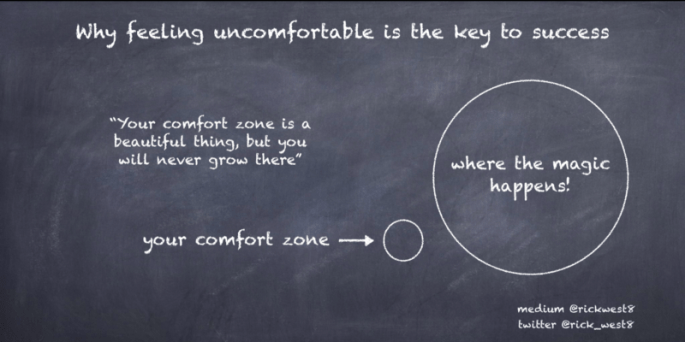
A comfort zone is a beautiful place, but nothing ever grows there.

Growth requires change. It requires discomfort. Ask yourself: are you comfortable with being uncomfortable? Can you go through the growing pains and make it out to the other side?

If you are going to win at this game we can life, it’s all about not letting your discomfort make you throw in the towel, not start the race, or give up in the middle.

You’ll get comfortable with being uncomfortable when you realize that pushing pass those feelings of discomfort and leaning into the discomfort is where you feel the most genuinely alive.  

You will also be able to handle WHATEVER life throws at you. Being comfortable with discomfort is the cornerstone of self-efficacy.

If you find you struggle with being uncomfortable and see it have a negative impact on your life, counseling may be a place to start processing through those feelings.

To schedule a counseling session with me (AND if you are a reader who lives in New Jersey):

https://anewcounselingservices.com/erin-theodorou%2Cm-ed-%2C-lpc

Erin Doyle Theodorou, M.Ed, LPC, NCC

Anew Counseling Services LLC

617 Oradell Avenue, Suite 3, Oradell, New Jersey, 07649

(551) 795-3822

etheodorou@anewcounselingservices.com


Everything Can Change, If YOU Can Change

abc


Change.

Many people HATE change. They fight it like hell. Resist it at ALL costs.

We all know people who will do ANYTHING to preserve the status quo.

But you can’t avoid change. The problem with hating change is life is FILLED with it.

Everyone, from every walk of life, must deal with change.

Change is always happening, but the way people react to change can be very different. Some people respond with fear, others respond with denial, others RELISH change.

What about you? How do you handle change?

Are you someone who puts off changes that you know need to be made?

Do you resist change to your own detriment?

Are you a person who creates opportunities for change because you view change as growth?

As humans, we are designed as a species that can adapt to all sorts of environments. If we weren’t CAPABLE of coping with change in all likelihood, we would be extinct.

For some people, they are not against change. But they may resist BEING changed.  It is the source of the change that matters to them.  Some people do not like change that is imposed on them—by say a boss, spouse, or some other external source.

Some people don’t mind change...depending how big the change is.  Perhaps they can change a small aspect of their life but anything they deem to big and threatening is out of the question.

The truth is we all HAVE different thresholds when it comes to our ability to adapt to change. What I can handle you may not be able to handle or vice versa. Being averse to change or embracing it is a very subjective experience.

It all comes down to how comfortable you are with uncertainty.. Ask yourself–would you rather be WRONG or UNCERTAIN?

Some people say better the devil they know because the risk of uncertainty is too UNCOMFORTABLE for them to handle. Even when on an intellectual level a person knows uncertainty also comes with the chance of things being BETTER.

Below is a quiz I came across, that takes only a couple minutes, to get a sense of how much change you feel comfortable with:

https://www.leadershipiq.com/blogs/leadershipiq/122984769-quiz-how-do-you-personally-feel-about-change

a5

If you find you want to change or need to change but have not been able to bring yourself to do so, you may benefit from working with a professional counselor.

Counseling can help you step out of your comfort zone to a more fulfilling, happier life. As you change your behavior, you identity starts to shift.  Our identity is NOT fixed, we are all capable of changing for the better.

The question is are you READY for a change?

To schedule a counseling session with me (AND if you are a reader who lives in New Jersey):

https://anewcounselingservices.com/erin-theodorou%2Cm-ed-%2C-lpc

Erin Doyle Theodorou, M.Ed, LPC, NCC

Anew Counseling Services LLC

617 Oradell Avenue, Suite 3, Oradell, New Jersey, 07649

(551) 795-3822

etheodorou@anewcounselingservices.com

Why Do People Live in Denial?

Being in denial about some aspect of our life is something that anyone and everyone is susceptible to. It’s a normal way of protecting ourselves to get us through some pretty tough situations.  Denial offers temporary relief.

Yet when we accuse someone of “being in denial” it is often used as a derogatory statement, referring to the notion that a person is avoiding or negating reality to their own detriment.

Denial is in play when some refuses to acknowledge the significance or consequences of certain behaviors. In the psychological sense, denial is a defense mechanism in which a person, faced with a painful fact, rejects the reality of that fact. 

A coping mechanism, such as denial, is an adaptation we make that enables us to deal with a difficult environmental stress that we feel we cannot change or eliminate.  The adaptation we make causes us to feel like we have control over the way we feel and behave. This is a false sense of control. 

Simply stated, denial is lying to yourself and believing the lie.

As a counselor, I often associate denial as a common defense mechanism of people who struggle with addiction issues.  Many addicts live in denial until they hit rock bottom.  Yet denial is also attributed to ANY person who does not want to acknowledge when bad stuff is happening in their lives, such as those who are attempting to cope with an unhealthy relationship, a life-threatening illness, a loss, abuse, or anything else that one may attempt to repudiate.

As human beings,  denial runs the gamut: people deny facts, responsibilities, the impact of their words & actions, and even the reality of their life. We can use denial to hide from any negative emotion, including embarrassment, shame, being afraid, guilty, depression.

When you’re in denial, you:

  • Won’t acknowledge the true extent of a situation
  • Try not to face the facts of a problem or the situation at hand
  • Downplay possible consequences of the issue

Some signs you may be in denial:

Do you ever…..

  • Think about how you wish things would/should be as opposed to reality of how they ARE?
  • Wonder, “If only, he (or she) would . . .?”
  • Make excuses for yourself?
  • Blame others?
  • Doubt or dismiss certain feelings you don’t want to face?
  • Conceal embarrassing aspects of your behavior?
  • Hope things will improve down the road magically?
  • Feel resentful or bitter?
  • Spend years waiting for things to improve or something to change?
  • Dread talking about problems? Refuse to face it in any real meaningful way?
  • Play the victim?
  • Feel regret?

If you find yourself answering yes to many of the aforementioned, you may very well be IN denial about some aspect of yourself, your relationship, or some element of your life.

a1

Denial is prevalent. When we can’t deal with, change or eliminate something painful, in order to avoid despair, we simply deny whatever is painful.

But to stay in denial, on some level you have to place yourself in a bubble, so as to stop seeing, feeling and hearing any proof to contradict it.  

Denial is a peculiar thing but it always serves the denier. Denial is a defense mechanism that discharges emotional discomfort. It is a form of self-deception. Yet if you are denying there’s a problem, just so you don’t have to feel bad about the fact that there is INDEED a problem, this is not good for your mental health and well-being.

Living in denial does not solve anything or make your life better. Denial is a form of psychological protection. We lie to ourselves to protect ourselves from certain truths we DO NOT WANT TO FACE, yet ironically the things we deny cause ourselves much more pain and suffering in the long run.

Denial is difficult to combat. That’s why it’s good to remember that while life is not completely in our control, that we are ALL in this boat. None of us are in complete control.  Yet it is important we take responsibility for the things we can control–our own words, actions, and behaviors. It can be nerve-wracking and can produce a lot of anxiety, but you do not have to be free from fear in order to act in ways that are necessary.  If you are in pain or hurting, acknowledge that.

Be courageous and face your life — and you’ll find a happier, healthier you on the other side.

To schedule a counseling session with me (AND if you are a reader who lives in New Jersey):

https://anewcounselingservices.com/erin-theodorou%2Cm-ed-%2C-lpc

Erin Doyle Theodorou, M.Ed, LPC, NCC

Anew Counseling Services LLC

617 Oradell Avenue, Suite 3, Oradell, New Jersey, 07649

(551) 795-3822

etheodorou@anewcounselingservices.com

Signs It May Be Time to See a Therapist to Get Help for Your Anxiety

Do you ever wonder if your anxiety is normal OR if it is time to seek out help for your symptoms? Shining a light on mental health issues helps to reduce the stigma that keeps many people from seeking support.

Anxiety is the most prevalent mental health disorder in America. Anxiety disorders are the most common mental illness in the U.S., affecting 40 million adults in the United States age 18 and older, or 18.1% of the population every year (adaa.org).

EVERYONE gets nervous from time to time. It is quite common for people to experience anxiety at different points in their lives.

For instance, anxiety is a very normal response to stressful life events like going on a job interview, getting married, having a baby, moving, changing jobs or having financial troubles. Anxiety is a natural reaction to a situation we perceive as stressful or dangerous.

But when does anxiety cross the line from normal anxiety into an anxiety disorder? When anxiety becomes larger than the events that triggered them and begin to interfere with your life, they could be signs of an anxiety disorder.

Anxiety disorders can become debilitating, but they can be managed with proper help from a mental health professional.

Anxiety disorders are HIGHLY TREATABLE if you are willing to take the first step towards seeking help.

Anxiety disorders can take many forms. Below are some signs you should consider seeking help for your anxiety:

1)If it keeps you from doing things you enjoy. When your world is becoming smaller because of your anxiety, this is certainly a sign you should seek help. Do you want to travel but suddenly feel the urge to cancel your plans because you are scared? Or do you feel too anxious to even book a trip in the first place because you are afraid to board a plane or be away from the comforts of home? Or you can only go to the same place for vacation because anywhere new and unfamiliar leads to high anxiety? Maybe you want to visit your sister but she lives two hours away and you are afraid to drive there. If your anxiety is inhibiting your life, it may be time to seek out professional help.

2)You are exhausted. Constantly feeling tired is a sign your mind (and your worries) are in overdrive. Worrying can lead to the point of exhaustion. Being easily fatigued can be a telling sign your anxiety is getting out of hand.

3)It is impacting your career. If you are so anxious, it is impeding your ability to function at work, it is time to seek out help. What are some signs your anxiety is severe?If you are finding that you are missing many days from work, frequently calling in late because your anxiety is impeding your ability to leave the house, or having trouble performing the normal day-to-day tasks of your job, it may be time to seek out some support.

4)You are isolating yourself from others. Are you feeling such anxiety that you are avoiding parties, going out, or interacting with family and friends? If your social anxieties are leading to isolation, this is a problem. If the presence of other people cause you to worry, you may feel the need to avoid putting yourself in situations where you have to interact with others you do not feel comfortable with. This is a sign your anxiety can be spiraling out of control.

5)Your fears keep you from performing essential tasks. Do you hate crowds? Get anxious waiting on lines? If your anxiety is keeping you from food shopping or going out in public, this is a sign your anxiety is disproportionate to the situation. If you can not perform day-to-day tasks because of strong, unrelenting feelings of anxiety, it can be a sign of anxiety disorder.

6)You are having panic attacks. The hallmark of a panic attack is extreme fear typically accompanied by rapid heartbeat, sweating, shaking, shortness of breath, chest tightness, nausea and fear of dying or losing control. Panic attacks can be terrifying. Counseling can help you figure out the situations, thoughts, or feelings that cause your attacks (your triggers).

7)The anxiety is ongoing. If you have been experiencing ongoing anxiety, it can be a sign of an anxiety disorder. Occasional anxiety is an expected part of life, ongoing anxiety is no,  unless it is circumstantial (you loss your job, getting a divorce, extenuating life circumstances that were unexpected, etc.).

8)You have physical symptoms–stomach aches, headaches, muscle tension, can’t sleep, dizziness, diarrhea, throwing up. Having physical symptoms on most days of the week is another frequent symptom of anxiety. There is no doubt that stress and anxiety can beat up your body. If your anxiety is causing you to become physically ill, you most certainly should seek out the care of a mental health professional.

9)Feeling irritable. Frequently, people with anxiety disorders experience excessive irritability.  Keep tabs on whether you’re blowing up at people or losing your cool. Do you let things that roll off other people’s back make you flip out? Are you unable to manage and control your emotions? It can be a sign you are emotionally dysregulated. Anger and irritability can be a sign of anxiety.

10)Trouble falling asleep or staying asleep. Sleep disturbances are strongly associated with anxiety disorders. Perhaps your mind starts racing as soon as your head hits the pillow. You’re thinking about your never-ending to-do list, that thing you should (or shouldn’t) have said at work, or how expensive your taxes are going to be this quarter. Then you catch a glimpse of the clock, and realize how late it already is which only further escalates your anxiety. Anxiety can lead to insomnia. If your anxiety is causing you to be restless and unable to get a good night’s sleep, you should speak to your doctor.

11)Your anxiety is impacting your relationships. Constant worry manifesting as any of the following: jealousy towards your spouse, your children becoming anxious themselves because you are rubbing off on them,  acting controlling towards others to mitigate your own anxious feelings,  avoiding friends and family at social events, and communication problems with others are ALL signs your anxiety has escalated to the point of a disorder. The good thing to know is that once treatment for anxiety is underway these relationship issues do improve as well.

a3.jpg

12)Using alcohol or drugs to self-medicate. Are you drinking more than usual? Popping pills to numb yourself out (especially if it not your prescription)? Many people who are suffering from severe anxiety will use drugs or alcohol to self-treat their anxiety symptoms.

If you are relating to many of the aforementioned signs, keep in mind, that anxiety is a very treatable disorder.

a1.jpg

If anxiety is interfering with your life, whatever they may mean to you, that is reason enough to speak with a mental health professional.

a2.png

If you anxiety is causing you suffering, you DESERVE to get help.

To schedule a counseling session with me (AND if you are a reader who lives in New Jersey):

https://anewcounselingservices.com/erin-theodorou%2Cm-ed-%2C-lpc

Erin Doyle Theodorou, M.Ed, LPC, NCC

Anew Counseling Services LLC

617 Oradell Avenue, Suite 3, Oradell, New Jersey, 07649

(551) 795-3822

etheodorou@anewcounselingservices.com