Regret: Are You Living or Merely Existing?

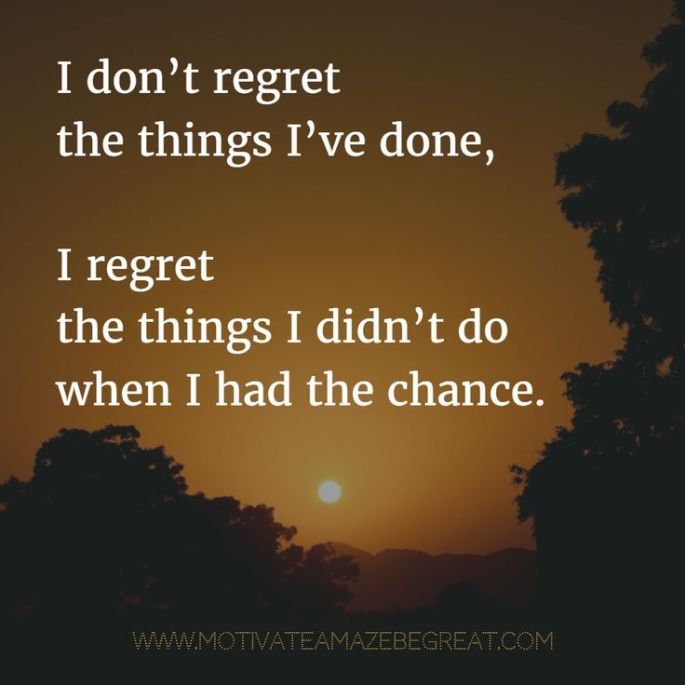
Who among us can say they have lived a life without ANY regrets?

a1.png

I would be suspicious of anyone who says they do not have at least a few regrets to their name (if they are passed a certain age that is).

Regret is an emotional state I wish on no one. Yet regrets are inevitable in life as we are all fallible human beings who make mistakes.

Thus maybe the best we can hope for in life is to have the right regrets.
a3.jpg

We are in the full swing of the holiday season. The holidays are a time of retrospection. If one struggles with regret, this time of year, it is sure to come to the surface.

Regret is common. Whether we acknowledge our regrets, to ourselves or others, is a separate issue.

Every one of us make mistakes in life. We ALL veer off course, make blunders, and fail. It’s is human nature.

Regret is a negative state that entails blaming ourselves for a bad outcome, feeling a sense of loss or sorrow at what might have been or wishing we could undo a previous choice that we made. 

Regret can be beneficial. It can push you to take corrective action–to attempt to right a past wrong. But some times there is no making right certain actions previously taken….and if that is the case you are likely to have chronic stress and ruminate over the past.  It is hard to move on when you cannot correct the mistakes of the past. In life, we don’t always get do-overs. This feeling of powerlessness and helplessness to change the past is one of the most horrendous aspects of regret.

We may regret how certain relationships unfolded. Most likely we will feel regret if our actions are to blame. Whether through not making the effort to stay in touch or from burning bridges. Inaction and undesirable action can both lead to feelings of regret.

Many of our chosen behaviors can lead to regret. Telling lies. Taking your loved ones for granted. Damaging a work relationship by blurting out something in the heat of the moment. Not following through on a promise to a client. Acting out our anger. Putting pride before those we care for.  Putting work before family. Putting our kids before our marriage. Perhaps we deny others happiness.  Or deny ourselves happiness. We may act against, not for other people. All sources of great regret later in life.

The thing is you see you reap what you sow. We all have the freedom to choose but we are not free from the consequences of those choices. This includes the emotional consequences of our choices.

Often times in counseling, I see people firsthand, face up to the emotional consequences of how they choose to live their life.

Regret comes from how we choose to live our life. Choices we made. Behaviors we executed. Or failed to execute. Regret is a painful emotion to face.

Here is a great article on the difference between regret vs. remorse.

https://www.psychologytoday.com/us/blog/stop-caretaking-the-borderline-or-narcissist/201507/regret-vs-remorse

Our regrets may arise from living unconsciously. We forget to live in the moment. We follow the goals set forth for us by our parents, society, anyone BUT us. We live a life pretending to be someone we are not. We do not stand up for ourselves or others. We disregard our health and wellness. We hold ourselves back. We refuse to let go. We resist change getting ourselves stuck while the rest of the world moves on.

Sadly as people we are not very good at predicting what will bring us most happiness in the future. We are not able to accurately think about our future selves (hence why so many people do not plan for retirement or watch their weight/monitor their health–because their future selves do not seem REAL to them).

In Daniel Gilbert’s book Stumbling on Happiness, Gilbert shows how terrible we are at predicting what makes us happy. If you don’t listen to your own deepest values, one day you’ll regret having taken life too seriously and worrying too much about what others think. You will regret living a life that was not true to who you are.

Regret arises when we engage in forms of self-sabotage.

How do we self-sabotage? Procrastination. Acting out our anger. Self-injury. Comfort eating. Avoiding the doctor. Inaction. Self-medicating. The list goes on and on.

Just because we are adult does not mean our dreams just go away. Yes, we get older and our priorities and responsibilities change, but we still have things we want to be and goals we want to fulfill. We all have an idealized version of our self in our mind,  and while we will never be able to achieve every goal we imagine, we can’t even begin to approach our ideal self without giving it a try.

So…what does YOUR ideal life look like?

If you had a second chance at life, what would you do differently?

It is never too late.

a4.jpg

So take a moment to reflect.

What goals have you never been able to pull the trigger on? What dreams have you started to pursue only to quit? People are far more resilient than we give ourselves credit for.

What people do you regret losing touch with? What bridges did you burn that you regret? People are amazingly forgiving, especially if you take all of the right steps, to rectify such behavior.

Counseling can be a helpful avenue to pursue to help you or someone you know cope with feelings of regret. When people spend years fixating on a regrettable choice they often need professional help to move past it, and seeking counseling can help people talk through, understand, and move beyond regret.

It is time to take responsibility for your own life and your own happiness.  All the often we merely exist instead of live. We all have hopes, dreams, and things we’ve always wanted to do in life, but we put them off until “tomorrow.” And tomorrow often never comes. Everyone experiences challenges, but we all have choices. It is up to you to get the ball rolling. Or live with regret. The choice is yours.

Ask yourself. Are you LIVING or merely EXISTING?

To schedule a counseling session with me (AND if you are a reader who lives in New Jersey):

https://anewcounselingservices.com/erin-theodorou%2Cm-ed-%2C-lpc

Anew Counseling Services LLC

617 Oradell Avenue, Suite 3, Oradell, New Jersey, 07649

(551) 795-3822
etheodorou@anewcounselingservices.com

December: A Time to Self-Reflect as Another Year Comes to an End

a1

At the end of each year, there is a great opportunity to reflect on yourself, your goals, your relationships, your career, and your health (both physical and mental).

December is an ideal time to take stock of how you feel you progressed the last twelve months. Perhaps to reflect on how you regressed (we are human after all).  Self-reflection is pivotal if you want to live your life by your own values, standards, and ambitions. It helps you build self-awareness. Our goals often become unrealized because we lack self-awareness. We live on auto-pilot. 

Self-reflection gives you the time to ask yourself the important questions. Without self-reflection it is easy to drift into a life of complacency. It is easy to become stagnant. People far too often take the path of least resistance. Just as you should review each day, week, and month, at the end of each year you should set aside time to review the year and reflect on how it unfolded. 

Are you happy with how your year turned out?

Are you happy with how your life has turned out?

December is a time of friends, fun, festivities, food, and family but most of all it’s a time of reflection and planning for the year ahead.

We all know January is notorious for short-lived resolutions. Yet in order to embrace the new, we must release the old. The old will block us from reaching our goals if we do not process through the past. The end of the year is an opportune time to think about what you accomplished, what you enjoyed, what you disliked, and what you want to improve upon in the new year. The new year is a great time to let go: let go of failed goals, past hurts, toxic people, your own negativity, and perpetual bad habits. Most importantly let go of things that are not meant for you: whether that may be goals that aren’t your own, certain relationships that bring you down, or your own self-defeating attitude. An important part of preparing for the New Year is to reflect on the past year—to release it—and to learn from it.…

If done right, it can also help you establish and achieve more meaningful goals.

I am a big believer in self-reflection to keep on track. As a therapist, I often reflect with my clients how they feel about the progression of their treatment and the counseling process. I am also a person who tries to make time to self-reflect on my own life. I aim to take time out of my schedule to ponder where I have been, where I am at presently, and where I would like to go. I reflect on what I am doing well, what I can do better, and am honest with myself about things I will never do well (the list is sadly longer than I care to admit 😉 ).

The end of the year is the perfect time to not just reflect on this past year, but to pay mind to where we are at in this stage of our life. Too often we are so caught up in our day-to-day lives, we fail to reflect on our journeys thus far.

Write out your thoughts and feelings. Do some journaling. Consider writing a letter—which can be a powerful self-development tool.  Consider writing a letter to people who hurt you–to get out the painful feelings and resentment (no, you do not actually send it). Process the pain of the past, take joy in the successes, and figure out how to forge ahead on the next chapter. 

Reflect upon what you did, how you felt, what you liked, what you didn’t and what you learned. What do you want to continue in the new year? What do you hope to change? Have you achieved any of your goals? Did you stumble on your pursuit of certain goals? What have you learned about yourself? About other people?

Consider making a list of all your goals for the next year, next 5 years, next 10 years, and a big picture life goal.

Grab a piece of paper and reflect on the following:

How did you grow this past year?

What’s not working in your life?

What is going well?

How is your attitude? Towards yourself and others?

Is your career heading in the right direction?

Are your finances where they need to be? Are you planning for the future?

Are you being the type of parent you would have wanted when you were growing up?

Are you being the type of person that you would want to spend time with?

Are you healthy? Physically? Mentally? Emotionally?

How are your relationships? With others? How about your relationship with yourself?

If your teenage self could see you now, what would he (or she) think?

What is one goal you have for EACH area of your life?

Have you traveled anywhere new?

Have you done ANYTHING to step outside your comfort zone?

Going forward, what kind of parent, sibling, professional, friend, partner (and other roles) do you want to be?

What do you want?

Self-reflection can be hard. It can be painful. But it can also be inspiring. It helps us to improve our lives and ensure we are living by our values.

Maybe this past year was awesome and full of joy. Maybe it was 12 months you’d rather forget. Either way a new year is upon us and it is up to you what you will make of it.

Give yourself the space and freedom to contemplate, to meditate, and to reflect on the past year.

It is time to start fresh. It is wild to me that a whole year has passed since the last one. They seem to go faster and faster with each passing year. We are all a year older. My questions for you: Are you a year wiser? Are you closer to reaching your goals? Are you willing to close the gap on your actual life vs. your ideal life?

Counseling can be a great place to start.

To schedule a counseling session with me (AND if you are a reader who lives in New Jersey):

https://anewcounselingservices.com/erin-theodorou%2Cm-ed-%2C-lpc

Anew Counseling Services LLC

617 Oradell Avenue, Suite 3, Oradell, New Jersey, 07649

(551) 795-3822
etheodorou@anewcounselingservices.com

a2.jpg


Practicing Humility: Why Pride is Nothing to Be Proud Of

c2

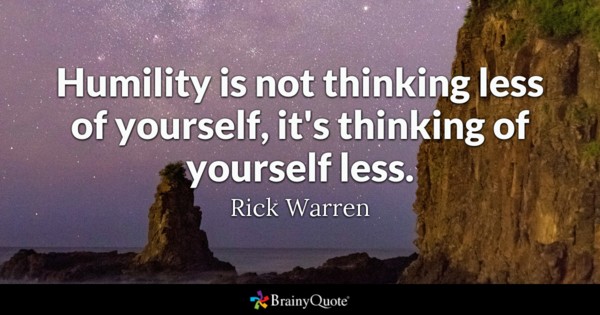
Humility is an under-appreciated quality in our society.

By definition:

  • humility

the feeling or attitude that you have no special importance that makes you better than others; lack of pride

Now, I ask, by this definition, do you feel you possess humility?
Or do you find that most people you encounter possess humility?


Humility is an important quality to possess. Being humble is about being self-aware–being able to recognize and accept one’s limitations as an individual and human being.

When you are humble you are able to put your strength, talents, and accomplishments in perspective.  You are also able to recognize the strengths, talents, and accomplishments of OTHER PEOPLE.

Humble people are able to value the well-being of other people–thus being both other regarding AND self-regarding.

It does not take long in getting to know someone to see if these possess a sense of humility.

Humility shines through in our interactions with others and the way we conduct ourselves in the world at large.

Humility is about modesty. It is a way of behaving where you do not act as you are better than other people or more important. Modesty entails letting other people shine and being able to appreciate the good in others. A modest person does not feel the need to diminish other people. Humility is when you no longer feel the need to put yourself above others, yet you don’t put yourself below them either.

Being prideful, arrogant, cocky—are all qualities that drive people AWAY from us. People will leave their interactions with a prideful person feeling disaffirmed, unappreciated, discouraged, invalidated, and dismissed.

c1

Being modest, humble, and possessing humility—are all qualities that drive people TOWARDS us. People will leave their interactions with a humble person feel affirmed, appreciated, encouraged, and validated by us.

There are many misconceptions we as a culture hold about humility.

Some people feel you can’t be humble AND ambitious at the same time. Or that being humble makes you appear weak. We live in a world where ego gets attention–just look at some of our political leaders at the forefront of the daily media news cycle. Arrogance and false bravado makes headlines whereas modesty seems to fade into the background. It is not as flashy as ego driven behavior so people tend not pay as much attention to modest displays.

More so, humility can feel soft at a time when problems are hard which makes the very proposition of humility feel very uncomfortable for many. To display humility, you need to be comfortable with being vulnerable–something people are often not comfortable with. This is driven largely by the misconception that humility is viewed as weakness by others.

Yet as human beings, we all have our days where our pride gets in our way. Our ego gets the best of us. We are human after all. But for many people pride drives their life and is a fixed characteristic.

pride

  1. high or inordinate opinion of one’s own dignity, importance, merit, or superiority, whether as cherishedin the mind or as displayed in bearing, conduct, etc.
  2. the state or feeling of being proud.
  3. a feeling or deep pleasure or satisfaction derived from one’s own achievements, the achievements of those with whom one is closely associated, or from qualities or possessions that are widely admired.

Yet pride as a personality trait is not something TO be proud of. Pride is often driven by poor self-esteem and shame. A person who feels so badly about themself that they compensate by feeling superior. They look for others’ flaws as a way to conceal their own. They relish criticizing others as a defense against recognizing their own shortcomings.

Ask yourself…

Are you confident and comfortable enough in who you are to stay humble? Are you brave enough to admit you don’t have all the answers?  These are not easy questions to answer for any of us.

To possess humility you need to tame your competitive reflex.  We need to fight the urge to show ourselves better than other people. In our culture, which very much is driven by a me first mentality, this can seem like a daunting task.

You may struggle with pride if you do any of the following:

~Offer unsolicited advice to others about how to live their lives

~Feel the need to one up people when they talk

~Always feel you have a better solution, suggestion, idea

~Feel the need to debate someone who has a different opinion than you to prove them wrong

~Feel you are owed something (entitled)

~Rarely say thank you

~Can’t ask for help

~Believe it is your way or the highway

~Often compare yourself to others

~Give your opinions about EVERYTHING

~Love to point out the faults in others

~Care too much about what others think of you

~Feel compelled to demonstrate how smart you, capable you are, accomplished you are (bragging)

~Feel compelled to use your kids to prop up your ego much to their dismay

~Tell people how to raise their kids better

~Refuse to admit when you are wrong

~Tell people how to manage their careers, relationships better

c5.jpg

The fact is humility is a reflection on how you truly feel about yourself. The greater your sense of self-worth, the easier it is to appreciate others, to praise them, and to encourage them.

We need more of that in our world.

Humility is realizing you’re just as valuable as every other human being on the planet, no more and no less. Remember that the idea is to be grateful, think of others, and embrace the virtues of humility. An idea we can ALL benefit from.

Counseling can help you gain perspective and develop healthier ways of relating to yourself and others.

To schedule a counseling session with me (AND if you are a reader who lives in New Jersey):

https://anewcounselingservices.com/erin-theodorou%2Cm-ed-%2C-lpc

Anew Counseling Services LLC

617 Oradell Avenue, Suite 3, Oradell, New Jersey, 07649
(551) 795-3822
etheodorou@anewcounselingservices.com


The Importance of Pro Social Behavior

a1.jpg

Pro social behaviors are those intended to help other people without an expectation of reward.

Pro social behavior is characterized by a concern for the rights, feelings, and welfare of other people. Behaviors that can be described as pro social can be characterized as expressing concern for others and feeling empathy. Pro social behavior is a way of acting in which you help other people.

Everyone can benefit from behaving in a pro social manner.  It will ensure we have better relationships with other people in our lives. In all likelihood we want to surround ourselves with people who behave in a pro social manner as well—people who express concern and empathy. Pro social behavior is crucial for enduring relationships. It is also beneficial to our mental health.

Being in education and mental health, my profession is by nature meant to be pro social. On a personal level, I derive many benefits from working in a “helping” profession.

Yet I feel we can all derive benefits from behaving in a pro social manner, regardless, of our profession. The opportunities for pro social behavior are all around us (especially this time of year). Volunteering, donating, altruism, care giving, helping our family and friends all create opportunities to be pro social.

We, as human beings, are designed to be pro social. We have an innate drive to do things for one another that is beyond our need to survive.  Pro social behavior enriches our lives and brings a sense of meaning.

Our world is in need of more pro social behavior. The benefits to us and others are tremendous.

Everyone can choose to behave pro socially. Acting out of genuine concern for other people and offering our help and support is something we all can all do.  If behaving pro socially is a value of ours.  In our society we have stopped seeing ourselves as part of a community, focusing more on our individual well-being. Not everyone cares to help anyone beyond themself. This is a sad truism. Yet behaving in a pro social manner is shown to have many psychological and emotional benefits.

Research reveals that those who act pro socially tend to be happier, healthier, and live longer. Those who don’t act pro socially tend to suffer the psychological cost that comes with guilt.

Empathy is a strong motive in eliciting pro social behavior.

Examples of pro social behavior might include:

  • Comforting a friend through a tough time
  • Surprising your coworkers with coffee in the morning
  • Donating clothes and toiletries to the local shelter
  • Helping a sick relative with getting to doctor’s appointments
  • Showing empathy to people in your life who are struggling through a tough time
  • Offering to cook dinner for a friend who recently gave birth

The examples are endless.

True pro social behavior is done out of a genuine desire to help. Thus if you are only volunteering or donating your money/time to post on social media or brag to family and friends–this is being driven more for one’s social status and image. Unfortunately,  people are generally much more likely to act pro-socially in a public setting rather than in a private setting. The reason being this has done with perceived status, being publicly recognized as a pro-social individual often enhance one’s self-image and desirability to be considered for inclusion in social groups. Volunteering has become a social class indicator and may drive some people’s volunteerism.

It is important to our society, our colleagues, our families, our extended social circles that we behave in a pro social manner in both public and private settings. It is inherently beneficial to ourselves and those we surround ourselves with. What good is it to volunteer at your church’s soup kitchen and come home and mistreat your own family?

Pro social behavior is important to our emotional and mental well-being. It allows us to interact with others in an appropriate manner.

We derive fulfillment from helping others. Find someone who needs what you have and help them earn it. Pay it forward.

There is no better feeling than extending a hand to another person.  This is the premise of pro social thinking.

What can you do today to be a benefit to your community?

To schedule a counseling session with me (AND if you are a reader who lives in New Jersey):

https://anewcounselingservices.com/erin-theodorou%2Cm-ed-%2C-lpc

Anew Counseling Services LLC

617 Oradell Avenue, Suite 3, Oradell, New Jersey, 07649

(551) 795-3822
etheodorou@anewcounselingservices.com


Emotional Dysregulation: Can You Recognize An Emotionally Immature Person?

a1

Can you recognize an emotionally immature person? A person whose emotional age is far behind their chronological age.

Of course, this does not include children and adolescents. Children and adolescents are not expected to have a full grasp of their emotions. Part of their development process is learning how to regulate and control their emotional responses.

Yet once we reach adulthood, you will encounter two distinct types of people: the emotionally mature and the emotionally immature. You will be able to detect quite quickly the type you are dealing with.

Emotionally mature people master control of their emotions meaning they are emotionally regulated. Emotional regulation involves maintaining thoughts, behaviors and expressions within a socially acceptable range. Therefore, you are not going to break down in tears in public or in the middle of a tense work meeting. You are not going to start screaming at other people or make a scene in public. You are not going to hurl insults and name call your coworkers or clients. You are able to appropriately respond to life stressors. Emotionally immature people never develop this ability and tend to struggle with emotional dysregulation.

Emotional dysregulation is a term used in the mental health community to refer to an emotional response that is poorly modulated, and does not fall within the conventionally accepted range of emotive responses. Possible manifestations of emotional dysregulation include angry outbursts or behavior outbursts such as crying or melting down, high levels of anxiety, being inflexible, aggression towards self or others, inability to adapt, etc.

Emotion dysregulation is associated with many psychiatric disorders such as major depression, PTSD and C-PTSD, mood disorders such as bipolar disorder, personality disorders such as narcissistic personality disorder/borderline personality disorder, and substance abuse.

Emotional maturity is defined by the ability to control your emotions and take full responsibility for your life.  A large part of being emotionally mature is having the ability to handle anger, disappointment, fear, jealousy, resentment, insecurity, and a myriad of other feelings appropriately. Emotional maturity is defined when you have the ability to experience these emotions and then let them go. People who are immature seem to remain stuck in these negative emotions, unable to get past them.

Emotional maturity is the ability to see life clearly and accurately, and to deal with it. Often we may not like how it is but we are mature enough to recognize that it is what it is. We are not in control of much in life–including circumstances and other people. For many of us, this is just a given.

Emotionally immature people cannot do this-they often expect life to be easy or comfortable all the time and if it isn’t—they look at who or what is to blame. They often try to control others and their environment since they struggle to control themselves. These are very childish people in terms of their emotional responses.

No matter who we are, we will all eventually meet, perhaps at work or our extended social circle, an impossibly immature person.  The person may look mature, and have many adult responsibilities, but emotionally, they are still a child. A person who can at times present themselves appropriately but can turn on a dime acting hurtful, rude, inappropriate, tactless,and dangerously childish whenever the need suits them.

Emotionally immature people can be extremely challenging to deal with, because their ability to interpret and react to the variety of life’s challenges is often impaired.

Emotional immature adults are known to throw “adult temper tantrums.”  Whereas adults tend to stay calm, emotionally immature adults are quick to anger and rage. They cannot control their emotions much like a toddler. They can cry uncontrollably and be unable to hold themselves together when confronted with the slightest inconvenience or the smallest amount of stress.

Now this is to not say we all do not have our moments. None of us are perfect and we all will have our off days. What I am talking about here is a pattern of behavior over time.

Emotionally immature people tend to struggle with emotional dysregulating i.e. the ability to regulate their emotion responses.

Whereas mature adults, respond not react, immature adults are impulsive and can blurt out hurtful, tactless words.  Mature adults recognize sometimes it is better to say nothing than to say something we will live to regret. We are not going to flip out on our boss because we got passed on for a promotion or tell our sister to screw off because we are upset with her. We are able to think before we speak as to not make things worse for ourselves (and others). This is because people who are psychologically mature have impulse control. Emotionally immature people never cultivated such an impulse control.

Often for one reason or another, the person never quite grew up.

Below are the telltale signs of an emotionally immature person:

  • A person who is emotionally immature will: be reactive; see himself as a victim; act out his emotions (intense or gut reactions, like explosive anger, sudden crying, etc)
  • A person who, like a two-year old will throw temper tantrums because they are entitled to get their way even to the detriment of those closest to them (they feel they have the right to attack anyone who thwarts their wants, needs, goals)
  • A person who is be self-centered and concerned with self-protection; appear to always be justifying his actions to himself or others
  • A person will be manipulative; be motivated by fear or a feeling that he “has to” do something,” as well as a need to avoid failure, discomfort, and rejection
  • A person who whines & complains frequently or literally acts like a crybaby
  • A person who must be right and is incapable of hearing differing viewpoints
  • A person who escalates things emotionally
  • A person who loves to blame and name call
  • A person who has a low frustration tolerance. They are not able to deal with every day stress. As the result, they will become excessively emotional
  • A person who speaks recklessly without thinking about potential consequences (adults resist the urge to react in order to avoid shooting out hurtful words/action–they self-soothe). Such a person believes they can blurt out whatever they think or feel even if it hurts or alienates those around them
  • A person who bullies. Adults respect boundaries.  Emotionally immature adults do not
  • A person who has immature defense mechanisms. Children tend to regard the best defense as a strong offense.  Similarly an emotionally immature adult attacks anyone who expresses a viewpoint different from what they want
  • A person who is passive-aggressive. Subtle insults, sullen behavior, stubbornness, or a deliberate failure to accomplish required tasks.

As we grow up and mature, we learn that much of life we cannot control including other people and circumstances. We recognize life is constant change. The ability to adapt and evolve is a must.

We recognize much of life is unfair.

We do not get the job we deserve. We are passed over for the promotion. We have health problems. Financial problems. People we love pass away. Friendships fade, relationships end. People we love move away. We do not have perfect parents, the perfect partner. We are not perfect partners or parents either.

Yet there is a sense of humility in the emotionally mature. With emotionally maturity comes the recognition that many things in life are complicated. We develop the ability to be comfortable with the uncomfortable. We humble ourselves when necessary. We also recognize most things will pass and get better. If we let them. But emotionally immature people cannot get out of their own way.

Emotionally mature people recognize the complexities of life. We will not always get what we want. We will be disappointed. We cannot always get our way. Things will not always go according to our plans. Other people will let us down. We will let ourselves down.

As a counselor, often what brings people initially into treatment is an ongoing struggle with an important relationship in their lives: spouse, child, parent, etc. Our level of maturity will determine how we manage everything in life including our relationships.

Emotional mature people are able to acknowledge others are entitled to live their lives the way they see fit, to not like us; to leave us. We understand others have the right to speak badly about us, or even to hate us. This is not to say we do not try to discuss it with the person at hand or make things better but we know that this is not always possible. As I wrote on a previous post, this is where it is important to be psychologically flexible.

Emotionally mature people recognize we are only in control of ourselves. This is where our power is. We can be agents of positive change or negative change, the choice is ours. Mature people recognize they are not entitled to anything in life. A mature individual does not lose control and give into irrational thoughts simply because they haven’t gotten their way.

As a clinician, it surprises me how many people growing up, were never taught coping skills. I have seen many people were never taught to self soothe or regulate their emotions. They never learned how to effectively handle the problems in their life or deal with stressors. Some people will not be able to cope with the difficulties of life and do not have the ability to face and overcome obstacles. These people will continue to exhibit childish behaviors.We all have our bad days but if you generally function as a grown-up, the more clear you are about what qualifies grown-up behavior, the more you will be able to stay a grown-up even when you are interacting with someone who is acting like a child.

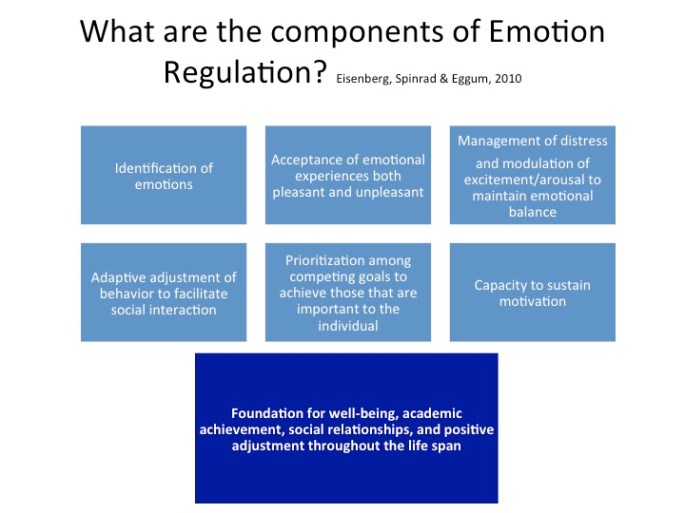
Emotion regulation is essential for healthy functioning (Grecucci, Theuninck, Frederickson, & Job, 2015). If you experience emotion dysregulation, you should consider seeking qualified professional help.

If you are interested in scheduling a session:

https://www.psychologytoday.com/us/therapists/erin-doyle-theodorou-nutley-nj/243617

Erin Doyle Theodorou, M.Ed., LPC, NCC

Theodorou Therapy, LLC

590 Franklin Ave.

Suite 2

Nutley, NJ 07110

973-963-7485

etheodorou@theodoroutherapy.com